

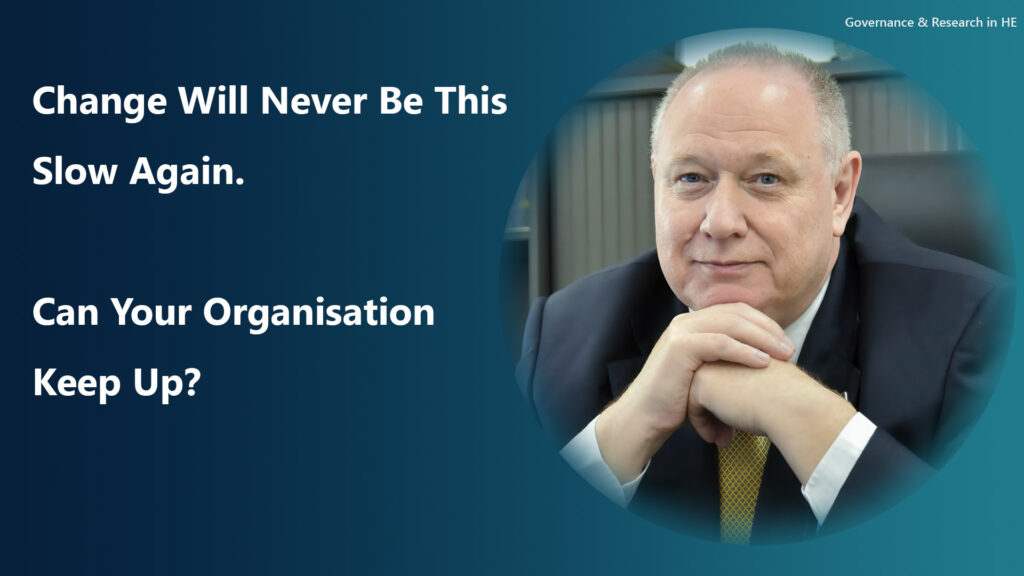
We often describe the current pace of change as unprecedented. Artificial intelligence is developing rapidly, new technologies emerge before organisations have fully adopted the previous generation, student expectations continue to evolve, and governments, regulators and competitors introduce new pressures. Leaders can be forgiven for feeling that they are operating in an unusually turbulent period and hoping that, once the present disruption has passed, things might settle down again.
I am not convinced they will. In fact, I suspect that this may be the slowest rate of change we will experience for the rest of our careers. Indeed, this exact point was made back in 2009 by Graeme Wood, who said “Change has never happened this fast before, and it will never be this slow again”[1]. Seventeen years on, I don’t think even Wood would have anticipated the rate of change we are now witnessing, and it shows no sign of slowing down.
That thought is both exciting and unsettling. It suggests that the leadership challenge is not simply to navigate the disruption we can currently see. It is to prepare our organisations for a world in which the interval between significant changes continues to shrink, new developments arrive before earlier ones have been fully understood, and adaptation becomes a permanent organisational capability rather than an occasional response to a crisis.
The Three Speeds of Change
There are, I believe, three different speeds operating around every organisation. The first is the speed of change in the external environment. Technology advances, regulation evolves, competitors innovate, business models are challenged, and expectations shift. Much of this happens beyond the control of any individual leader or institution.
The second is the speed at which leaders recognise what is happening and adjust their thinking. Some leaders can question an assumption, change direction and make a decision relatively quickly. Experience, curiosity, confidence and a willingness to acknowledge that yesterday’s answer may no longer be adequate all influence this personal capacity to adapt.
The third speed is more difficult. It is the speed at which colleagues and the organisation itself can absorb and implement change. A leader may understand the need for a new direction within days, but explaining it, building confidence, addressing legitimate concerns and helping hundreds or thousands of colleagues move with them will take much longer. Even when staff are willing and able to adapt, the organisation’s structures and systems may prevent them from doing so at anything like the pace required.
This is why individual adaptability, although important, is not enough. A leader who changes quickly can still find themselves at the head of an organisation that moves slowly, with all the frustrations that this brings.
Organisations Move at the Speed of Their Constraints
In operations management, there is a simple but powerful principle. A system is rarely constrained by its best-performing component. Its overall performance is determined by its bottleneck. Improving other parts of the system may create the appearance of progress, but it produces little overall benefit if the underlying constraint remains unchanged.
Organisations are no different. We can recruit adaptable people, provide training, encourage experimentation and ask colleagues to become more agile. Yet the organisation will not necessarily move any faster if its decision-making, governance, financial or technological systems cannot support that agility.
The rate at which an organisation can change is determined not by its most adaptable people, but by its greatest organisational constraint.
That constraint is unlikely to be a single reluctant colleague. It may be a committee structure that requires several months to approve a decision, a budgeting process that fixes priorities for a year at a time, a procurement framework that cannot respond quickly to new requirements, or a legacy information system that makes apparently straightforward changes difficult and expensive. It may be a policy framework that has grown incrementally over many years, with each new rule created for a sensible reason but the combined effect making the organisation increasingly difficult to navigate.
This distinction matters because it changes the leadership response. If we assume that people are the problem, we focus on persuasion, communication and training. Those may all be necessary, but they will not remove a structural bottleneck. Leaders must also be willing to examine whether the organisation itself is preventing capable and willing people from acting.
The Paradox of Stability
This challenge is particularly acute in higher education because universities were not designed to move quickly. Their governance arrangements encourage consultation, scrutiny and careful deliberation. Academic quality processes protect standards, policies provide consistency, and committee structures ensure that decisions are not taken without considering their wider consequences. These are not weaknesses. They are among the features that have helped universities maintain trust and legitimacy over long periods.
However, the same characteristics also introduce inertia. A process that provides valuable scrutiny is now an obstacle as it contains unnecessary stages. Consultation can improve a proposal, but it can also be a way of postponing a difficult decision, even to the point where it never sees the light of day. Policies can ensure fairness and consistency, yet their cumulative effect can leave an organisation trying to address tomorrow’s challenges through rules written for yesterday’s circumstances.
Leaders therefore face a genuine tension. They cannot simply remove safeguards in the name of speed, because an organisation that changes rapidly but carelessly may lose quality, trust and coherence. Equally, they cannot allow stability to become an excuse for institutional immobility.
The goal is not to create universities that change quickly at any cost. It is to create universities that can change thoughtfully at the speed that their environment requires.
Taking colleagues with us
There is also a human dimension that cannot be reduced to organisational charts or approval processes. Even where the case for change appears obvious to a leader, colleagues may view it from a very different position. They may be responsible for implementing the change, concerned about unintended consequences, uncertain about whether the latest initiative will survive, or simply fatigued by a succession of previous changes that were announced enthusiastically but never fully completed.
Good leaders do not dismiss these concerns as resistance. They recognise that moving an organisation requires more than issuing instructions. Colleagues need to understand why change is necessary, what it will mean for their work, what will remain stable and how they will be supported. Trust becomes especially important when the future cannot be described with certainty.
This is another reason why the leader’s personal speed cannot determine the organisation’s pace. A senior leader may have spent weeks thinking about an issue before sharing a conclusion. Colleagues encounter the idea for the first time when it is announced and understandably need time to understand, question and assess it. What feels to the leader like a long-delayed decision may feel to everyone else like a sudden change of direction.
The answer is not to slow every decision until everyone is completely comfortable. That would be impossible. It is to build an organisation in which change is expected, communication is credible, concerns can be raised honestly and colleagues believe that their leaders will listen without abandoning the need to act.
From Managing Change to Building Adaptability
Organisations often treat change as a temporary programme. A project team is created, a plan is approved, milestones are monitored and eventually the organisation is expected to return to normal. That model assumes that change has a beginning and an end.
Increasingly, it does not. By the time one transformation has been implemented, the external environment may have moved again. Artificial intelligence is the most visible current example, but it is unlikely to be the last. The deeper issue is acceleration, not any single technology.
This means that leaders must move beyond becoming better at individual change projects. They need to build organisations that are capable of continual adaptation. That involves reviewing where decisions are made, how quickly resources can be redirected, whether policies remain fit for purpose, and whether systems enable or obstruct the people who use them. It also requires greater clarity about what should not change, because organisations need stable values and purposes even when their methods and structures evolve.
Adaptability does not mean constant restructuring. An organisation that repeatedly redraws its structure without improving its underlying capability may simply create disruption. Genuine adaptability is the capacity to learn, decide and respond without requiring a crisis before action becomes possible.
A Leadership Question for the Future
Most leaders already recognise that the world is changing. The more difficult question is whether the organisations they lead are capable of changing with it. Personal agility matters, but it has limited value when colleagues are not brought into the process or when organisational systems make action unnecessarily slow.
The defining leadership challenge may therefore be less about predicting the next disruption and more about increasing the rate at which an organisation can absorb change without losing trust, quality, coherence or purpose. That will require leaders to identify bottlenecks, distinguish necessary safeguards from inherited bureaucracy, and design organisations in which capable people are able to act.
If this really is the slowest change we will ever experience, then waiting for the world to settle down is not a strategy. The question is whether our organisations were designed for the speed of the world that is now emerging.
Did you find this edition useful?
I publish two free weekly newsletters exploring different aspects of higher education, research and scholarly publishing. If you enjoyed this edition, you may also find value in the following.
Governance & Research in HE
A weekly brief for higher education leaders and researchers examining governance, leadership and research in practice.
Publishing with Integrity
Examining scholarly publishing through an ethical lens, challenging assumptions and supporting academic career development.
About the Author
Professor Graham Kendall is Vice-Chancellor of GlobalNxt University, Malaysia, and an Emeritus Professor at the University of Nottingham. Throughout a career spanning academia and industry, he has held senior leadership roles across research-intensive and teaching-focused universities. Through Governance, Leadership & Research in Higher Education, he shares practical reflections on leadership, governance and institutional strategy, drawing on both operational experience and academic research to encourage informed discussion across the higher education sector.
[1] https://web.archive.org/web/20160330011408/http://graewood.blogspot.com/2009/09/ipasocial-principle-9-change-will-never.html [The web archive link is given as the original link is not robust]