

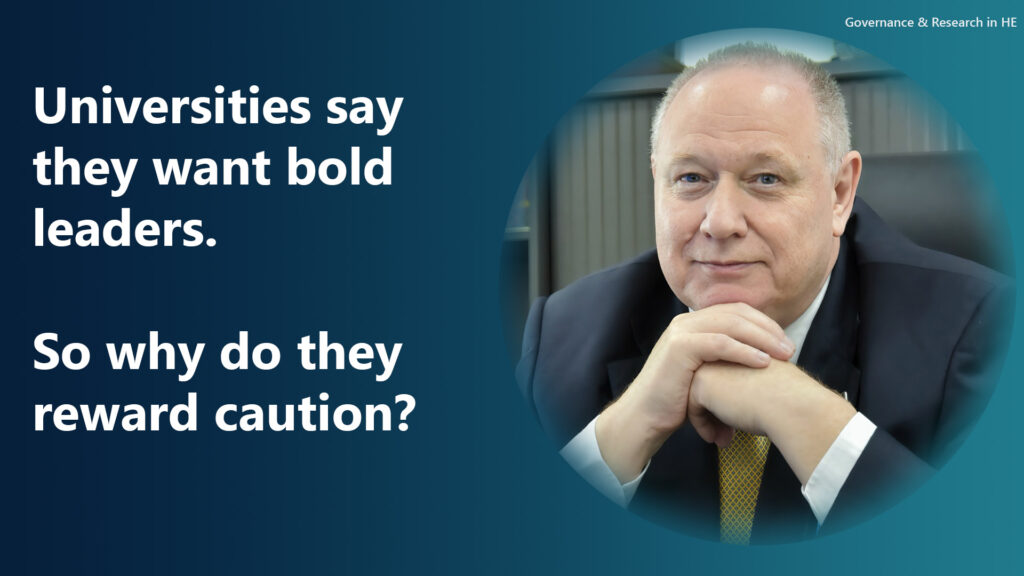
The language of bold leadership
Universities often speak confidently about the kind of leadership they want. They talk about transformation, innovation, agility, strategic repositioning and the need to rethink old assumptions. They say higher education needs leaders who can navigate uncertainty, make difficult decisions and move institutions forward in a fast-changing environment.
This is now almost standard language. It appears in strategy documents, recruitment briefs, conference panels and board discussions. Institutions present themselves as ambitious, forward-looking and ready to adapt.
The gap between rhetoric and reality
But there is often a gap between how universities describe themselves and how they actually operate. More importantly, there is often a gap between the kind of leadership they say they want and the freedom they are willing to give leaders in practice.
The sector is undoubtedly under pressure, and the old ways of working are no longer enough. But that creates an obvious question: can universities really deliver change through systems that still reward caution?
There is a tension here that is worth paying attention to.
Although universities often say they want bold leaders, many of their systems still reward caution. Not always deliberately, and not always consciously, but in practice the signals are often clear. Leaders may be praised for vision, but they are often judged more harshly for visible mistakes than for quiet stagnation. They may be encouraged to think creatively, but expected to operate within cultures that are deeply risk averse. They may be appointed on the promise of change, only to discover that the institution is far more tolerant of careful continuity than meaningful disruption.
That gap between what is said and what is rewarded matters. In fact, it may be one of the most important leadership issues in higher education.
The problem is not that universities value stability. Of course they do, and in many respects they should. They are not start-ups. They carry public responsibilities, educate students, employ large communities of staff and operate within layers of accountability, regulation and governance. Recklessness is not a virtue in such settings, and not every call for “boldness” is wise. A mature institution should not lurch from one grand initiative to another.
The real question is different. It is whether caution has become so embedded in the culture of leadership that it is now rewarded even when change is clearly needed.
When caution becomes the safer choice
One reason this happens is that visible failure is usually treated more seriously than slow decline. A leader who takes a bold decision and gets it wrong will often be remembered for it. The mistake is identifiable. It can be discussed, criticised and attached to a person or a team. A leader who avoids difficult decisions, preserves weak systems or postpones necessary reform may do far less obvious damage in the short term. The institution continues to function. Meetings still happen. Reports are still written. Targets are still discussed. Nothing dramatic appears to have gone wrong.
Why drift is harder to see than failure
In many universities, the cost of drift is much harder to see than the cost of a failed initiative. Yet drift can be more damaging over time. An institution can lose momentum, fall behind competitors, frustrate staff, disappoint students and entrench inefficiencies without any single moment that forces a reckoning. It simply becomes slower, heavier and less capable of change. Because that deterioration is gradual, it often attracts less criticism than a visible attempt at reform that does not succeed.
If that is the environment in which leaders operate, then caution becomes understandable. Indeed, it becomes rational. People respond to the incentives around them. If the message, implicit or explicit, is that visible risk is dangerous but invisible stagnation is tolerable, then many (arguably) sensible leaders will moderate their ambitions accordingly.
How leadership culture teaches caution
This is where the culture of leadership begins to matter. Institutions often like to imagine that they reward courage, imagination and strategic clarity. But leadership culture is not defined by slogans. It is defined by repeated signals. What gets praised? What gets challenged? What gets quietly resisted? What is tolerated year after year? What creates political difficulty? What is forgiven, and what is not?
Over time, leaders learn the answers to these questions very quickly. They learn which proposals will be welcomed, which will trigger resistance, and which are likely to be sent into the long grass under the language of further consultation. They learn where the real boundaries are. That learning may not make them weaker leaders, but it often makes them more cautious ones.
Complexity, consultation and delay
Complexity plays a major part in this. Universities are difficult places to lead, and that is not merely an excuse. They are full of professional expertise, competing values, distributed authority and legitimate stakeholder interests. Good university leadership is rarely about command and control. Consultation matters. Collegiality matters. Process matters. Decisions often have consequences across multiple parts of the institution, and simplistic solutions are rarely helpful.
Moreover, complexity can become a very convenient reason not to act. When every issue has multiple dimensions, every decision can be postponed, perhaps more meetings are needed, more information is required or more consultation needs to be undertaken. When governance structures are layered, difficult choices can be slowed by procedure. When cultures are cautious, the call for more discussion can become a respectable way of saying no without actually saying no.
Most experienced leaders will recognise this. There are times when institutions appear busy, thoughtful and engaged, yet somehow remain strangely immobile. There is activity, but little movement. Plenty of consultation, but limited resolution. Strong language about change, but very little that feels genuinely transformative.
That is one of the most frustrating aspects of leadership in higher education. The language of urgency can coexist quite comfortably with the habits of delay.
Why institutions often choose reassurance
This tension also appears in the way leaders are selected. Universities often say they want candidates with vision, energy and the ability to lead change. Search processes describe a need for strategic thinking, innovation, resilience and the confidence to navigate a demanding external environment. Yet appointment systems can also favour something rather different: reassurance.
Candidates who appear balanced, diplomatic, careful and unlikely to unsettle too many people often feel safer to appoint. That is not irrational. Institutions under pressure often prefer a leader who can manage relationships, avoid unnecessary turbulence and present a calm public face. Those are valuable qualities. But there is a difference between choosing a thoughtful leader and choosing the most comfortable option.
When bold leaders are admired too late
The uncomfortable truth is that genuinely transformative leaders are not always reassuring at the point they arrive. They ask awkward questions. They expose weaknesses. They challenge longstanding assumptions. They create discomfort before they create progress. Institutions often celebrate such leadership once success is visible. They are less enthusiastic when the disruption is still unfolding and the outcome remains uncertain.
In that sense, bold leadership is often admired retrospectively. Once the risk has paid off, it is described as courageous and strategic. Before that, it may be seen as divisive, premature or politically difficult. This is one reason why institutions can believe they value bold leadership while repeatedly rewarding caution.
Stability, strength and inertia
Another issue is that universities sometimes confuse stability with strength. Stability can be a sign of resilience, coherence and mature judgement. But it can also be a sign of inertia. A calm institution is not always a healthy one. Sometimes calm simply means that difficult issues are being deferred, underperformance is being accommodated, and the cost of avoidance has not yet become fully visible.
This matters because higher education is not operating in a stable external environment. Demographic shifts, financial pressure, changing student expectations, geopolitical uncertainty, technological change and increasing scrutiny are all putting institutions under strain. In that context, the ability to adapt is not a luxury. It is part of institutional survival. A university that rewards caution too consistently may feel well managed, but it may also become brittle.
None of this means that leaders should simply be more aggressive or more disruptive. That would be too crude. The issue is not whether caution is ever appropriate. It obviously is. The issue is whether institutions have created conditions in which responsible boldness is genuinely possible.
Can universities really tolerate responsible boldness?
It is much harder to ask whether boards and senior teams can distinguish between prudent challenge and reckless behaviour. Whether institutions can tolerate discomfort when trying to transform is a question we have to ask. Are leaders given enough trust and support to take difficult decisions before a problem becomes a crisis? Perhaps more importantly, does the system really want to change, or do we only want the appearance of change without the cost that comes with it.
The institutional question
This is why the question is not just about individual leaders. It is about institutional design. A university can recruit talented, thoughtful and ambitious people into senior roles, but if the culture punishes visible risk more than quiet drift, those leaders will adapt. Some will become more cautious. Some will focus on what is survivable rather than what is necessary. Some will learn to speak the language of transformation while delivering only what the institution can comfortably absorb. And some will leave.
The final question
Perhaps the real question is not whether universities want bold leaders. Many probably do, at least in principle. The more difficult question is whether they are prepared to create the conditions in which bold leadership can survive.
Because if caution remains the safest route to acceptance, progression and institutional comfort, then bold leadership will remain something universities praise in speeches and celebrate in hindsight, rather than something that they truly enable in practice.
And if that is the case, then perhaps the sector does not really have a shortage of courageous leaders. Perhaps it has a shortage of institutions willing to back them.