

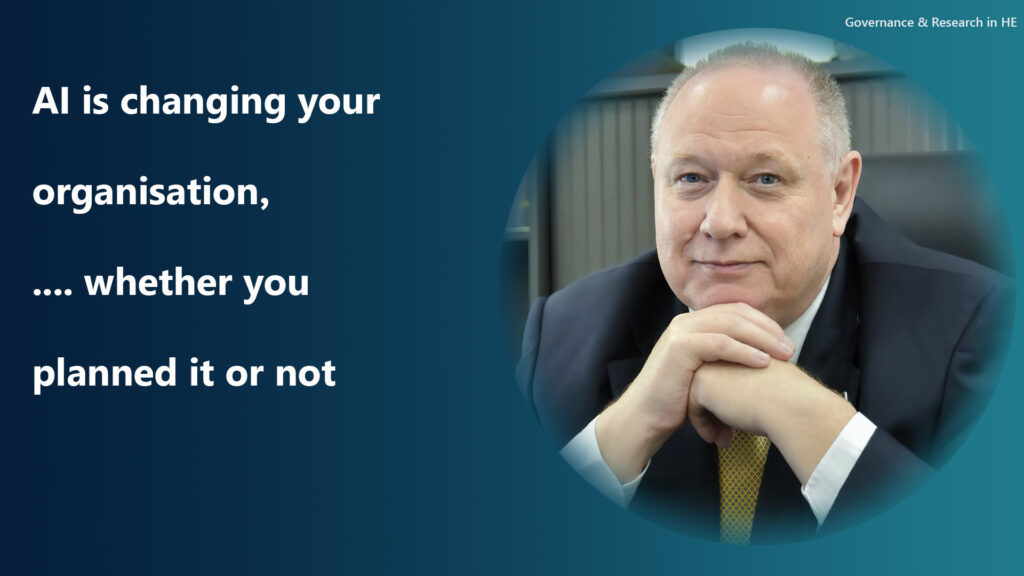
In a recent edition of this newsletter, I asked whether we are creating two classes of employee: those who know how to use AI effectively and those who do not.
That divide matters at an individual level. Two people doing nominally the same job may have very different levels of productivity because one has learned how to use AI to research, analyse, draft, summarise, automate and solve problems, while the other continues to work much as they did before.
But there is a second question that may be even more important. What should organisations do about it?
Much AI adoption appears to be driven by individuals. Some people are naturally curious. They experiment with new tools, develop prompts, build workflows and gradually change the way they work. Others engage much less, perhaps because they are sceptical, cautious, busy, unsure where to begin or simply not interested.
That might have been acceptable when AI was a useful tool, but no more than useful. It becomes much harder to justify if AI fundamentally changes how work is done. AI capability may now be too important to leave to individual initiative.
Having an AI policy is not enough
Many organisations have spent significant time and effort developing policies around the use of AI. That is understandable, and the right thing to do. There are legitimate concerns around confidentiality, data protection, intellectual property, accuracy, bias, security and the appropriate use of externally hosted systems. Employees need to know what they can and cannot do.
But an AI policy and an AI strategy are not the same thing.
A policy asks questions such as: What tools are permitted? What data may be uploaded? When must AI use be disclosed? What activities are prohibited?
A strategy asks a different set of questions. How can AI improve what we do? Which processes should change? What capabilities do our staff need? Where would investment best be directed? How will we measure whether AI is producing a return on investment?
Put more simply:
AI policy asks, “What are employees allowed to do?”
AI strategy asks, “What do we want the organisation to become?”
An organisation may need both, but having the first does not mean it has the second.
Stop leaving capability development to chance
The people who are currently becoming highly capable AI users are not necessarily doing so because their organisation trained them. In fact, I suspect that AI training is the exception rather than the norm.
In truth, your staff may have spent more time experimenting, which is a good thing, especially in this day and age of lifelong learning and continual professional development.
However, it creates an unusual form of organisational inequality. Two people with similar qualifications, experience and job descriptions may gradually develop very different capabilities because one has invested heavily in learning how AI can support their work – while the other has not.
The obvious response is training, but that needs some thought and planning.
Generic sessions on “How to use AI” may have limited value. The useful applications of AI for somebody working in finance may be very different from those for an academic, marketing professional, HR manager, administrator or senior executive. Another challenge is that people will be at different stages of AI development. What is an advanced course for one person may be something that another person mastered months, if not years ago. A further challenge is what tools do you use? Do you use ChatGPT, Gemini, or one of the many other AI tools that are there? And do you use a free version, with limited credits, or a paid-for version where you can do a lot more?
There is another complication. The people who are already highly capable may continue learning much faster than everybody else. That is, they may be on a much steeper part of the learning curve. Training cannot simply bring everyone to some fixed level. The target is moving, and the pace of that movement is accelerating.
Managers need to understand the work they are managing
There is another group whose AI capability may be particularly important: managers.
Suppose an employee discovers that AI can reduce a task that previously took three hours to 45 minutes. What should their manager conclude, if indeed they know – the employee may not necessarily volunteer the fact to get some free time to spend on social media and chatting to friends?
If an employee is now much more productive, should the expected workload for everybody change? Should the process itself be redesigned so that AI is incorporated into the workflow? Should the time saved be redirected towards higher-value activity?
These are management questions, but answering them requires at least some understanding of what AI can, and cannot, do.
There is a risk that employees become more technologically capable than the people managing them, a topic I touched on in a recent edition of this newsletter. That is not necessarily a problem in itself. Managers have never needed to possess every technical skill held by their teams, but they do need to know what their teams are doing, what they are capable of and how long it takes them to complete a given task/project.
That is, they do need enough understanding to judge performance, allocate resources and recognise when assumptions about workload have become outdated.
If AI materially changes how long work takes, managers who do not understand AI may find themselves managing against an increasingly unrealistic picture of how work is actually being done.
Turn individual experimentation into organisational learning
There is also a knowledge management problem. Imagine that one employee develops a particularly effective way of analysing reports, preparing proposals or processing routine information using AI.
What happens next?
In many organisations, perhaps nothing. The new approach remains personal knowledge. The employee becomes faster or better at the task, but the organisation itself has not necessarily learned anything. That is a lost opportunity.
Organisations need ways to identify useful AI practices, test them, improve them and share them. A successful workflow should not remain as somebody’s private “trick”.
This does not mean that every clever prompt should be stored in a central database. AI use is becoming more sophisticated than that. Increasingly, the valuable knowledge may lie in a workflow: which tools are used, what information is supplied, what checks are made, where human judgement is required and how the final result is validated.
That starts to look less like individual productivity and more like organisational process design.
Decide what productivity is for
Perhaps the most important question is what the organisation wants to do with the productivity gains. Suppose AI enables a team to complete its existing workload in 20% less time. What happens to the 20%?
Does the organisation expect 20% more output? Does it reduce staffing? Does it improve quality? Does it shorten turnaround times? Does it give employees more time for creative, strategic or relationship-based work? Does it redesign the job entirely?
There is no single correct answer. But there does need to be an answer.
Improving productivity sounds like an obvious objective, but productivity is only useful if the organisation knows what it wants to achieve with the capacity that has been created.
Otherwise, employees may quite reasonably make their own decisions. Some will produce more. Some will spend more time refining their work. Some will take on additional responsibilities. Some may simply finish earlier.
AI strategy therefore cannot just be about acquiring tools or teaching people how to use them. It also has to address what the organisation wants to do differently once those tools start working.
Who is designing your future organisation?
This issue becomes more significant as we move from generative AI towards agentic AI. Much of the early discussion around AI focused on individual tasks. Draft an email. Summarise a report. Analyse some data. Produce a presentation.
Agentic systems go further by linking tasks together and carrying out larger parts of a workflow.
At that point, we are no longer simply asking whether an employee can perform a task more quickly. We may be asking whether the task needs to exist in its current form at all.
That is an organisational design question. And this is where leadership becomes important.
If an organisation has no deliberate approach to AI deployment, it does not mean that its operating model will remain unchanged. It may simply mean that change happens informally and without its leaders necessarily being aware of it.
Individual employees will automate what they can. Teams will adopt different tools. Some managers will encourage experimentation while others discourage it. Useful knowledge will remain local. Different parts of the organisation will move at very different speeds.
Over time, the organisation may change quite substantially without anybody ever consciously deciding what the new organisation should look like. Furthermore, the more these changes become embedded in the daily work practices, the more difficult it will be to change in the future to achieve better alignment across the organisation.
That leads to the question I think leaders increasingly need to ask:
If we do not have a deliberate AI strategy, are we effectively allowing our future operating model to be designed by whichever employees happen to experiment fastest?
Perhaps that is not necessarily a bad thing. Some of the best innovation has always come from employees experimenting with better ways of working. But experimentation and strategy are not alternatives. The challenge is to allow people to experiment while ensuring that the organisation learns from what they discover.
AI capability is rapidly becoming an organisational capability. If that is true, it may be too important to leave entirely to chance.
If you liked this edition
I publish two free LinkedIn newsletters:
Governance, Leadership & Research
Thoughts on leadership, universities, research, AI and organisational life.
https://www.linkedin.com/newsletters/governance-leadership-research-7304751583412932608/
Publishing with Integrity
Exploring research integrity, academic publishing and the systems surrounding scholarly communication.
https://www.linkedin.com/newsletters/publishing-with-integrity-7312447317984972800/
You can also find previous editions on my website:
About the Author
Professor Graham Kendall is Vice-Chancellor of GlobalNxt University, Malaysia. He has held senior leadership positions in higher education for more than 15 years, including roles as Vice-Chancellor, Provost and CEO, Pro-Vice-Chancellor, Deputy Vice-Chancellor and Vice-Provost.
He is an Emeritus Professor at the University of Nottingham and has published extensively in artificial intelligence, operational research and related areas. His current interests include university leadership, research governance, artificial intelligence and scholarly publishing.