

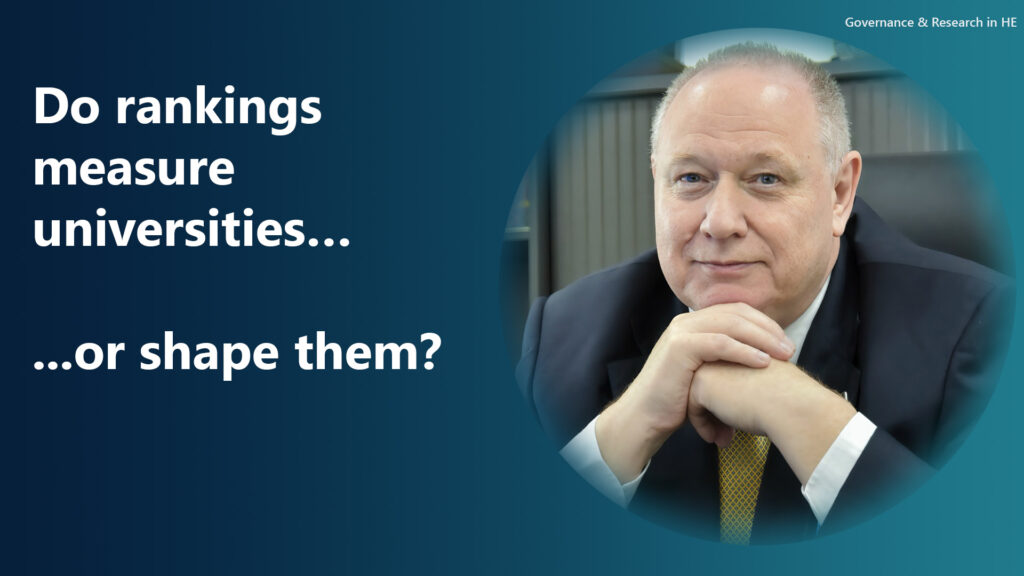
University rankings are usually presented as measurement systems. They compare institutions, assess performance and provide a shorthand way of understanding the global higher education landscape. Governments refer to them. Students consult them. University leaders analyse them carefully.
Because of this, rankings are often discussed through the lens of evaluation. They are seen as tools that measure institutional quality and provide information about how universities perform relative to their peers.
Yet this description captures only part of their influence.
In practice, rankings do not simply measure universities. They shape them, sometimes despite what the formal strategy says.
When metrics become incentives
Any metric that is measured regularly eventually becomes an incentive. This is often an unintended consequence, but it is a predictable organisational response.
If an institution knows that citation impact influences rankings, it may encourage researchers to publish in journals that maximise citation visibility. If international faculty ratios affect position in a league table, recruitment policies may shift accordingly. If reputation surveys carry significant weight, institutions may invest considerable effort in global visibility and brand perception.
None of these actions are inherently problematic. In many cases they are entirely rational responses to how performance is assessed.
But they illustrate an important point.
The indicators used by rankings do not simply record what universities do. They quietly encourage universities to behave in ways that improve those indicators, even if that is at odds with the formal university strategy.
Over time, this influence becomes embedded in institutional actions and becomes normal, even if nobody ever said that this is the behaviour that was encouraged or even expected.
The emergence of “ranking-aware” strategy
Universities don’t always declare that their strategy is designed around, or at least recognises, rankings. Indeed, many universities will outwardly say that they do not chase rankings, when the opposite is the case.
Rather, strategic plans usually refer to academic excellence, global engagement, research impact and student success.
Yet inside institutions, ranking indicators are often analysed in minute detail. Breakdowns are produced. Benchmarking exercises compare institutional performance with peers. Committees examine how small changes in indicators might affect future positions.
In this way, rankings often become an implicit reference point for institutional planning.
Decisions about research investment, international partnerships, faculty recruitment and even disciplinary priorities can sometimes be influenced by how they might affect ranking performance.
Over time, institutions may become what could be described as “ranking-aware organisations.”
They do not necessarily design their strategy around rankings. But they remain constantly conscious of them, recognising that the rankings are an important part of how their institution is perceived.
When measurement shapes behaviour
Metrics rarely remain neutral for long.
Once a measure becomes visible, comparable and influential, people begin to respond to it. They adjust behaviour, consciously or unconsciously, in ways that improve performance against the measure.
Economists sometimes describe this phenomenon through Goodhart’s Law: when a measure becomes a target, it ceases to be a good measure.
In the context of university rankings, the effect is more subtle. Rankings do not usually dictate behaviour directly. But they influence the environment in which decisions are made.
Institutional leaders may ask themselves questions such as:
- Will this decision strengthen our research indicators?
- Will this partnership improve our international profile?
- Will this initiative affect our ranking position?
Even when these questions are not dominant, they are often present in the background.
The strategic dilemma for universities
This creates a dilemma for institutional leadership.
On one hand, rankings clearly matter. They influence student choices, international reputation, partnership opportunities and sometimes even government policy. Ignoring them entirely would be unrealistic.
On the other hand, allowing rankings to shape institutional priorities too strongly can create unintended consequences.
Universities might favour activities that improve measured indicators rather than those that best serve their mission. Certain disciplines may receive more attention because they produce highly cited outputs. Activities that are harder to quantify, such as community engagement or local impact, may receive less visibility.
The risk is not that universities pursue rankings deliberately. The risk is that rankings quietly reshape institutional priorities without anyone formally deciding that they should.
A governance perspective
From a governance perspective, the key issue is not whether rankings are good or bad. The real question is whether institutions remain conscious of the influence rankings exert on their behaviour.
Metrics can be valuable tools when they inform judgement. They become problematic when they replace it. Therefore, university leaders have an important responsibility. Rankings should be analysed, understood and interpreted carefully. But they should not quietly become the invisible architecture that determines, or even undermines, institutional strategy.
Otherwise, universities may eventually find themselves optimising performance against a set of external indicators rather than pursuing their own academic mission.
A question for leaders
Rankings will almost certainly remain a permanent feature of global higher education.
They provide information, shape perceptions and influence behaviour in ways that are unlikely to disappear.
But an important question remains.
Are rankings simply measuring universities?
Or are they quietly shaping what universities become?
About the author
Professor Graham Kendall is a higher education leader and researcher who has worked across the UK and Asia for more than three decades. He has held senior roles including Vice-Chancellor, Provost and Deputy Vice-Chancellor, and has extensive experience in university strategy, research evaluation and international higher education. Alongside his leadership work, he has published more than 300 peer-reviewed papers and has a long-standing interest in how metrics, incentives and governance structures influence academic behaviour.
Having worked closely with global rankings and research performance frameworks, he has seen how these systems can shape institutional decisions, sometimes in ways that are not immediately visible.
If your institution is thinking about rankings strategy, research evaluation or the governance of performance metrics, he is always happy to exchange ideas and share experience.