

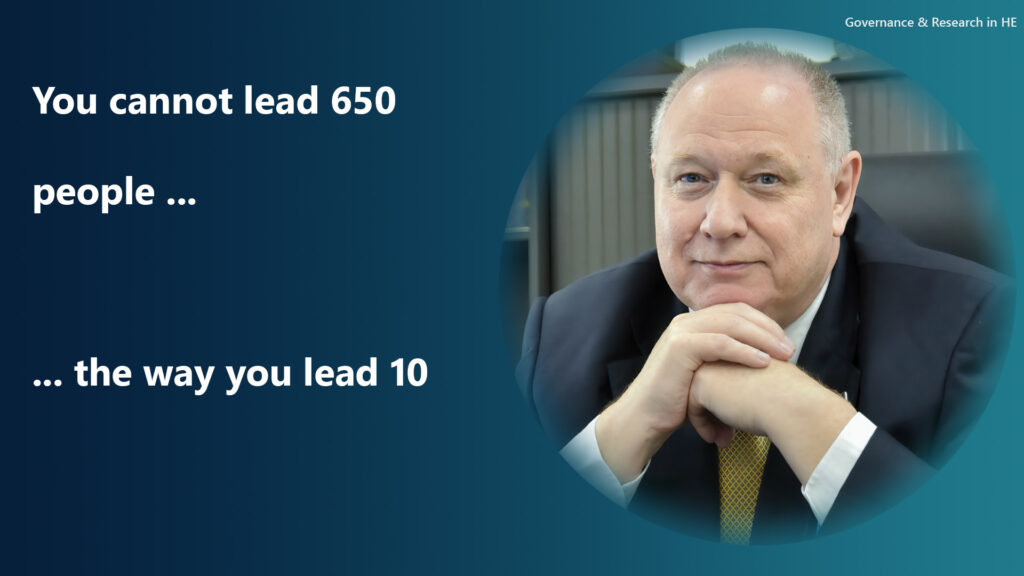
In my first higher education leadership role, I could probably have done the job of almost everyone who reported to me. I had “been there and done that”. I understood the roles, I knew the problems they were likely to encounter and I could usually offer practical advice when they needed it.
I was also confident that I could step in and do the task if that was what I needed to do, although I resisted doing that as much as possible. Instead, I managed and delegated, and I think I did reasonably well. But behind that delegation was the reassuring knowledge that I could check what people were doing, recognise whether it was being done well and, when necessary, get my hands dirty.
It was also a relatively small team of around 10 people. I knew each of them personally, understood something of what motivated them and could have one-to-one conversations whenever they were needed. Leadership was exercised through direct relationships and a detailed understanding of the work.
Then I moved into a much larger role.
When the familiar model stopped working
I was now responsible for an organisation in which around 650 people ultimately reported through to me, alongside various contract staff. Functions such as Finance, Human Resources, Communications, Marketing, and Estates came within my area of responsibility, along with several others.
The scale was different, but that was only part of the challenge. I was now responsible for areas in which I had limited, if any, professional experience.
I could read basic financial documents, but I was not an accountant. I did not know employment law in the way that an experienced HR professional would. I could not advise anyone on building regulations, and communications and marketing had never been a substantial part of my previous work.
Even if there had been enough hours in the day, I could not have done the jobs of the specialists who reported to me. Nor should I have tried.
Looking back, I think this was when I began to make the real transition from managing a team to leading an organisation.
Expertise can become a constraint
People are often appointed to their first leadership position because they are good at what they do. In higher education, that might mean being an accomplished researcher, an effective teacher or an experienced administrator. Their expertise gives them credibility and helps them understand the work of those they lead.
This can be valuable in a relatively small team. Problems arise when the same model is carried into a much larger role.
A leader who is accustomed to being the expert may continue to believe that leadership means knowing more than everyone else, checking their work and becoming involved whenever a problem arises. At a larger scale, that approach is impossible. It can also be damaging.
Trying to remain involved in every detail slows decision-making and weakens the authority of the people appointed to lead particular functions. Senior colleagues may begin to wait for approval rather than exercise their own judgement. The organisation becomes dependent on one person, while that person becomes increasingly overwhelmed.
The skills that helped someone succeed in an earlier role may therefore become the very habits they now need to leave behind.
Leading specialists
Leading people whose professional knowledge exceeds your own requires a different kind of confidence. You must be willing to acknowledge that you do not know exactly what they do, while still taking responsibility for it.
I did not need to know more about employment law than the HR team. But I did need to understand the consequences of the advice I was receiving. I did not need to be able to prepare detailed financial accounts. But I needed to understand the financial position, recognise the risks and ask whether the assumptions behind a proposal were reasonable.
The senior leader’s contribution is often found in the questions they ask. What problem are we trying to solve? What assumptions have we made? What are the risks? What alternatives have been considered? Who will be affected? What would happen if the situation changed?
These questions do not replace specialist expertise. They help the organisation use that expertise well.
There is also value in bringing together perspectives that might otherwise remain separate. A financial decision may have implications for staff. An HR decision may affect reputation. An estates project may influence student recruitment and student experience. Functional specialists will naturally view a problem through their own professional lens. A senior leader must see how the different parts connect.
Trust is not the absence of scrutiny
Delegation at this level depends on trust, but trust cannot mean accepting everything without question. Equally, scrutiny should not become an excuse for micromanagement.
Finding the balance is difficult. If leaders involve themselves too deeply, they undermine the people they have appointed. If they remain too distant, they may discover too late that assumptions were flawed, risks were overlooked or problems were being concealed.
The answer, in my experience, lies in establishing clarity. People need to understand what they are responsible for, what outcomes are expected and when an issue should be escalated. Senior leaders need reliable information, meaningful measures and opportunities to challenge proposals constructively.
They also need to know the people to whom they have delegated authority. Do they exercise sound judgement? Are they open about problems? Do they listen to their own teams? Will they raise an uncomfortable issue, or will they tell the leader what they think the leader wants to hear?
Trust develops through repeated experience. It is neither blind nor automatic.
Leading at a distance
There was another significant difference between leading 10 people and being responsible for an organisation of around 650. In the smaller team, I could learn a great deal through everyday contact. People could speak to me directly, and I could often sense when something was not quite right.
That becomes harder as an organisation grows. Information travels through several layers before reaching the senior leader, and it can become filtered along the way. By the time a problem reaches the top, it may have been simplified, softened or presented with a solution that leaves little room for discussion.
Senior leaders therefore need ways of remaining connected to the wider organisation. They must listen beyond their immediate team, create opportunities for people to speak honestly and pay attention to information that does not fit the prevailing narrative.
But this must be handled carefully. Speaking directly with staff should help a leader understand the organisation. It should not become a way of bypassing or undermining those who carry formal responsibility.
A change in professional identity
Perhaps the hardest part of this transition is psychological.
Expertise is reassuring. It allows us to contribute directly, solve problems and demonstrate our value. Many academics have spent years becoming recognised authorities in a particular area, so it can be uncomfortable to enter a role in which much of the important work lies outside their expertise.
A more senior title does not remove that discomfort. Indeed, it may intensify it because the consequences of decisions are greater.
The temptation is to retreat towards the areas we understand. An academic leader may devote disproportionate attention to research or teaching because those areas feel familiar, while paying less attention to finance, HR, estates or marketing. Yet the unfamiliar areas may present some of the institution’s greatest risks.
Leadership at this level requires a different understanding of personal contribution. Your value no longer depends primarily on having the answer. It comes from appointing capable people, asking informed questions, making connections, exercising judgement and creating the conditions in which others can succeed.
Preparing people for the transition
Higher education often prepares people for promotion by giving them progressively larger versions of what they already know. A successful academic might become a head of department, then a dean and eventually a member of the senior leadership team. But the change between these roles is not simply a matter of scale. At some point, the nature of the work changes.
Institutions should prepare leaders for more than larger budgets, bigger teams and more meetings. They need opportunities to understand unfamiliar professional functions, learn how to challenge specialist advice, delegate genuine authority and remain connected to an organisation they can no longer know personally.
Mentoring can be particularly valuable because some of these lessons are difficult to capture in a leadership course. New senior leaders need somewhere to discuss uncertainty without feeling that they are exposing weakness. They need help recognising when to become involved, when to ask another question and when to trust someone else to do the job.
For me, the decisive transition came when I could no longer rely on being able to do everyone else’s work. I had to accept that leadership did not require me to know everything. It required me to build an organisation in which the right people could contribute their knowledge, challenge one another and take responsibility for the decisions within their remit.
Perhaps that is one of the clearest signs that someone has moved into organisational leadership: they stop measuring their value by how much of the work they could do themselves and start measuring it by how well the organisation works without their direct involvement.
I publish two free newsletters each week
Governance & Research in HE
A weekly brief for higher education leaders and researchers examining governance, leadership and research in practice.
https://buff.ly/GhsZqVl
Publishing with Integrity
Examining scholarly publishing through an ethical lens, challenging assumptions and supporting academic career development.
https://buff.ly/WiG1yFb
If you subscribe, you will be alerted whenever I publish a new edition.
About the author
Professor Graham Kendall is Vice-Chancellor of GlobalNxt University and an Emeritus Professor at the University of Nottingham. He has held senior leadership positions in higher education for many years, including roles as Vice-Chancellor, Provost, Pro-Vice-Chancellor and Vice-Provost. His academic work spans operational research, artificial intelligence, scholarly publishing and higher education leadership.