

The universe is almost impossible to comprehend
I have been watching quite a few videos recently about the size of the universe. As tends to happen with social media, once you watch a few, many more start appearing in your feed. I find them fascinating, partly because no matter how often the numbers are explained, they never really become intuitive.
If you want to get some idea of the scale of the universe, here is one video I watched:
Even our own galaxy, the Milky Way, is around 100,000 light-years across. The nearest star beyond our Sun is more than four light-years away, and once we move beyond our immediate neighbourhood, the numbers quickly become so large that they cease to have much intuitive meaning. You can be told that something is a million light-years away, a billion light-years away or tens of billions of light-years away, but I am not sure that the human mind can really comprehend what those distances mean.
We can repeat the numbers, construct models and watch clever animations that try to put the scale into perspective. But there comes a point where the numbers become almost abstract. The universe is simply too large for us to truly get our heads around, and of course it is still expanding.
There are vast regions of the universe that we will never visit. Even if we could travel at the speed of light, which we cannot, parts of the universe would still remain unreachable.
There are places so distant that we may never even be able to observe them. Realistically, humanity may never travel even to the nearest star, let alone explore more than a tiny fraction of our own galaxy. It was while watching one of these videos that another thought occurred to me: AI is beginning to feel a little like that.
Welcome to the AI universe
I am obviously not suggesting that AI operates on anything remotely approaching the physical scale of the universe. But there is something similar about the feeling it creates.
Almost every day there seems to be a new model, a new capability, a new AI tool, a new use case, a new company or a new way of working. We now have AI systems that can write, analyse, code, create images, generate video, search the web, interrogate large collections of documents, conduct research, work with spreadsheets, interact with software and increasingly carry out multi-step tasks on our behalf.
And that list will almost certainly become outdated remarkably quickly. Even people who follow developments in AI closely cannot realistically keep up with everything that is happening because there is simply too much.
For somebody who has not yet started using AI seriously, that must be daunting. They may look at everything that is happening and wonder where they are supposed to begin.
When the scale becomes the barrier
That question worries me because the sheer scale of AI may now be putting some people off engaging with it at all. If you believe that you need to understand the available models, know which tools are best, understand prompting, learn about agents, investigate automation and somehow keep track of everything that is changing, the easiest response is to do nothing.
You might conclude that everybody else has already moved too far ahead, that perhaps you should have started years ago, that you have missed the opportunity, or that it is now simply too difficult to catch up.
I think that is completely the wrong way to look at it. In fact, it reminds me of my relationship with another piece of software: Photoshop.
I avoided Photoshop for years
I regard myself as very computer literate. I started my career in computing, have been using computers professionally for most of my working life and have conducted research in computer science. Yet for years, I avoided Photoshop.
Whenever I opened it, I found it intimidating. There seemed to be menus everywhere, tools I did not understand, layers, masks, channels, filters and countless other features whose purpose was far from obvious. So I did what many people do when faced with something that looks too complicated: I found ways not to use it.
For an embarrassingly long time, Microsoft Paint was my preferred option simply because I understood it. Eventually, though, I had a project where Paint was simply not up to the task. I needed something more capable, so I finally forced myself to learn Photoshop.
It took a while, but something interesting happened. I did not learn Photoshop, at least not all of it. I probably learnt about 20% of what Photoshop could do, but that enabled me to do about 80% of what I actually needed. And that was good enough.
That changed everything. I stopped worrying about all the features I did not understand and concentrated on the ones that were useful to me. Over time, whenever I needed to do something new, I learnt another feature. Today, I use Photoshop almost every day and it is one of the most useful tools I have. I still do not know everything it can do, but I do not need to.
Perhaps we are approaching AI in the wrong way
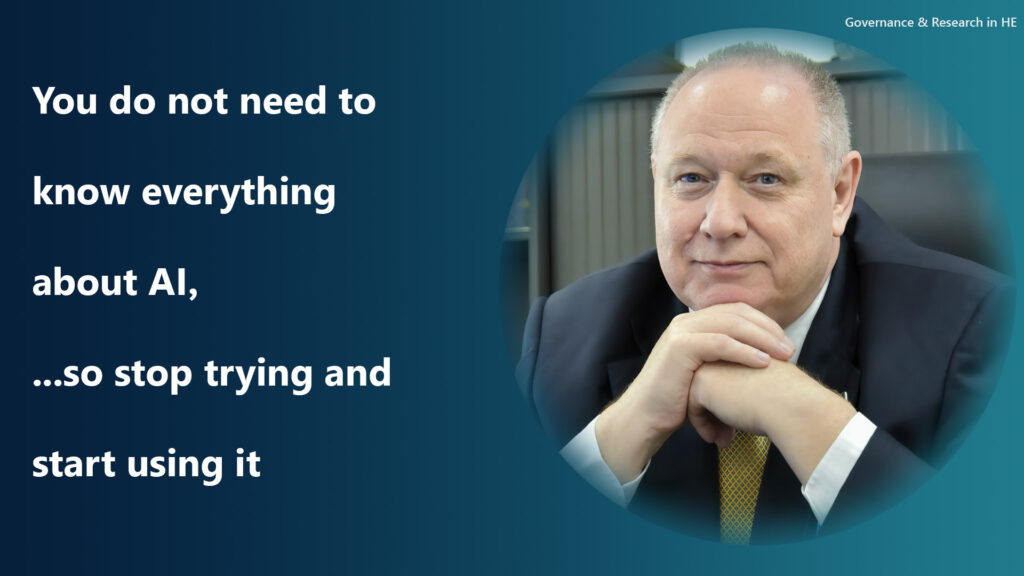
I think that there is an important lesson here for AI. The mistake is believing that you need to understand AI before you start using it. In reality, using it is how you begin to understand it.
You do not need to understand every model. You do not need to know every AI product on the market, and you certainly do not need to understand every new capability announced each week. You only need to find something useful.
Perhaps that is asking AI to help draft a document. Perhaps it is using it to summarise a long report, analyse a spreadsheet, improve a presentation, conduct some initial research, generate an image, write some computer code or simply help you think through a problem. Once you have found one genuinely useful application, you begin to see where else it can help.
The next step becomes much easier because you begin asking what else you could use it for. That is when learning becomes driven by need rather than by an impossible attempt to understand everything.
Just start somewhere
If you have not yet seriously started using AI, do not begin by trying to understand the whole AI landscape. tart somewhere, anywhere.
Ask a colleague who uses AI to show you what they do. Watch a few videos. Attend a webinar. Take a course. Ask your organisation whether it provides training. Experiment with one of the major AI tools and give it a real problem that you are currently working on.
Most importantly, do not wait until you feel that you understand enough to begin, because you probably never will. That is not a criticism. It is simply a consequence of how quickly the field is developing.
The goal is not to become an expert in everything AI can do. The goal is to become sufficiently comfortable that you can recognise where it might help you.
You will never keep up with AI
I doubt that any of us will ever keep up with everything happening in AI, and perhaps we should stop trying.
We do not need to explore the entire universe to learn something valuable from the small part of it that we can observe. AI may be similar. The AI universe is going to continue expanding, and there will always be tools we have never used, capabilities we do not understand and developments we have missed.
That does not mean we are too late. It simply means that trying to understand everything is the wrong objective. Find the part that matters to you, start there, and then keep exploring.
If you liked this edition
I publish two free weekly newsletters on LinkedIn.
Governance, Leadership & Research explores leadership, higher education, artificial intelligence, governance and the changing nature of work.
https://www.linkedin.com/newsletters/governance-leadership-research-7301541017843630080
Publishing with Integrity examines research integrity, academic publishing and the systems that support, and sometimes undermine, scholarly communication.
https://www.linkedin.com/newsletters/publishing-with-integrity-7312975032118366208
If those topics interest you, you are very welcome to subscribe.
About the Author
Professor Graham Kendall is Vice-Chancellor of GlobalNxt University, Malaysia, and an Emeritus Professor at the University of Nottingham. He has held senior leadership positions in higher education for more than 15 years, including Provost, Pro-Vice-Chancellor, Deputy Vice-Chancellor and Vice-Provost roles.
His academic background is in computer science, artificial intelligence and operational research. He has published more than 300 peer-reviewed papers and has held editorial roles with several international journals.