

Researchers often ask “Where can I find a list of predatory journals?”
It’s a reasonable question. The world of scholarly publishing has become increasingly complex, and researchers want a straightforward way to identify journals they should avoid. Many people assume that somewhere there must be a reliable list. A single place that provides a clear answer. Unfortunately, the situation is not that simple.
The expectation of a list
In many areas of life, lists are useful. Airlines maintain no-fly lists. Financial regulators maintain watchlists. Universities maintain lists of approved vendors. It is therefore natural that researchers expect something similar for scholarly journals.
If predatory publishing is a recognised problem, then surely there must be a list of those journals that are considered predatory.
The rise of Beall’s List
Perhaps, the closest thing the academic community has ever had to a definitive list was created by Jeffrey Beall, an academic librarian at the University of Colorado. Beginning in the early 2010s, Beall maintained a blog that listed publishers and journals he believed were engaging in predatory practices. The list quickly became widely known and widely used.
For researchers trying to navigate the expanding open-access publishing landscape, it provided something that had previously been missing. A reference point. Universities recommended it. Librarians cited it. Researchers consulted it before deciding where to submit their work.
For several years, Beall’s List effectively became the go-to resource for identifying questionable journals.
However, the list was also controversial. Some critics argued that the criteria used for inclusion were not sufficiently transparent. Others suggested that the list focused too heavily on open-access publishers while overlooking problematic practices elsewhere in scholarly publishing.
In 2017, the blog hosting Beall’s List was suddenly taken offline. Although archived versions of the list remain available, it has not been maintained since. It is now about fifteen years since the list first appeared and almost a decade since it was actively updated.
From my point of view, Beall deserves recognition for starting the list and maintaining it for the time that he did. Yes, it was controversial, yes, it was not clear why a given journal was included on the list and, yes he was targeted by publishers, but he was still the person who raised the issue of predatory journals and brought it to the attention of the scholarly community[1]. If you are interested, in my 2021 article “Beall’s legacy in the battle against predatory publishers”, I discuss Beall’s legacy, which includes a list of his articles which address predatory publishing[2].
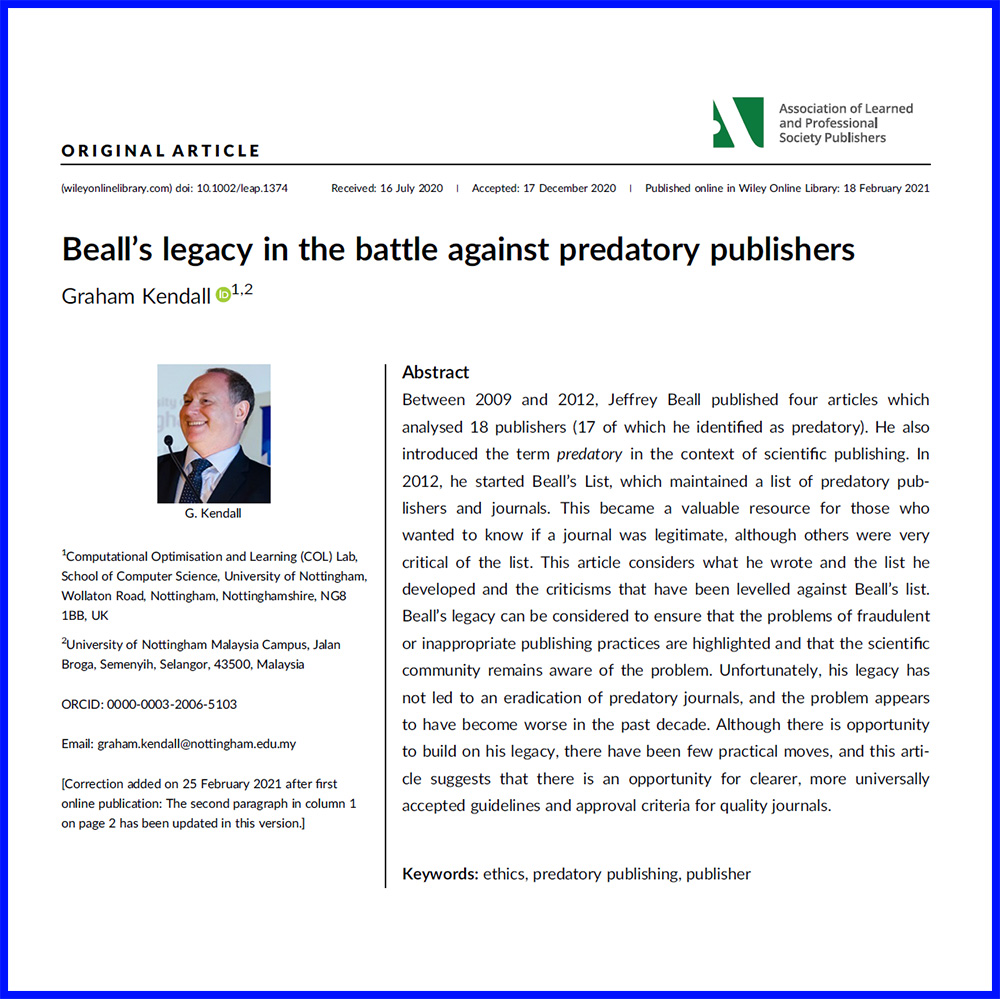
Kendall, G. (2021) Beall’s legacy in the battle against predatory publishers. Learned Publishing, 34 (3): 379-388. http://dx.doi.org/10.1002/leap.1374
Why has no single list replaced Beall’s List?
If Beall’s List filled such an important role, why has no equivalent resource replaced it?
In fact, there are several initiatives. Resources such as Think. Check. Submit. encourage authors to evaluate journals before submitting their work. Organizations such as the Directory of Open Access Journals (DOAJ) maintain curated listings of journals that meet certain standards. Cabells provide predatory reports, albeit through a subscription-based service.
Each of these resources contributes something useful. Yet none of them has become the universally accepted reference point that many researchers expect, unlike Beall’s List which was where everybody went to check whether a journal was predatory, or not.
Part of the reason is practical. Maintaining a comprehensive and accurate list of questionable journals would require constant monitoring of thousands of publishers and tens of thousands of journals. New journals appear every year. Existing journals change ownership. Editorial practices or publication models change, for good or for bad. A static list would quickly become outdated. But the difficulty runs deeper than that.
The definition problem
Perhaps the most fundamental challenge is that there is still no universally agreed definition of what constitutes a predatory journal. Some cases are obvious. Journals that promise publication within days, provide little evidence of peer review, and charge large fees are widely viewed as problematic.
However, many journals exist in a grey area. Some may have weak editorial processes but operate in good faith. Others may charge high article processing charges while maintaining legitimate peer review. Even well-established publishers occasionally face criticism over editorial practices, publication standards or being too profit focussed.
Because scholarly publishing operates along a spectrum rather than a clear binary divide, drawing a definitive boundary between legitimate and predatory journals is extremely difficult. Without agreement on the definition, it becomes almost impossible to maintain a universally accepted list.
The limits of lists
Lists also create another problem. They encourage a form of binary thinking: a journal is either on the list or it is not. In reality, the quality and integrity of journals cannot always be reduced to a simple yes-or-no classification. A journal that is not classified as predatory is not necessarily trustworthy. Equally, the presence of a journal on a list does not automatically mean that every article published in that journal is flawed.
Scholarly publishing is a dynamic ecosystem. Journals evolve. Publishers change. Editorial standards improve or decline over time. A list that attempts to capture this landscape will always struggle to keep pace with those changes.
A different question
Perhaps the real question is not: Where is the list of predatory journals?
Instead, we might ask: Why do we expect such a list to exist at all?
The appeal of a list is obvious. It offers a simple solution to a complex problem. But scholarly publishing may be too complex for that solution to work reliably.
A governance challenge for universities
If a universal list of predatory journals is unlikely to emerge, an important question follows. Why is it so difficult to build one? Part of the answer lies in the lack of agreement about what a predatory journal actually is.
Given this, how should institutions help their researchers navigate the publishing landscape?
Some universities have already taken steps in this direction. For example, many institutions require approval before article processing charges are paid from central funds. Others provide guidance on reputable publishers or recommended indexing services.
It may be possible to go further.
Institutions could develop clearer internal frameworks that help researchers assess journals before submission. These frameworks might consider factors such as indexing status, editorial transparency, peer review processes and publication practices.
Such approaches would not eliminate every risk. However, it would shift the focus from searching for a single global list towards developing institutional responsibility for publication decisions. This may be beneficial as each institution could tailor the list to align with their strategic plans.
The reality
Predatory publishing remains a significant challenge for the research community. Researchers, understandably, want a simple way to avoid problematic journals.
Yet the solution that many people expect, a definitive list, may never exist. The publishing landscape is too complex, too dynamic and too contested for a single list to capture it reliably.
The list that everyone wants may simply be a list that nobody can build. The real challenge may not be identifying predatory journals but designing research systems that do not reward them. One way in which this could be achieved is by universities themselves not recognising the journals that some of their scholars publish in.
Your thoughts
What do you think?
- Do you think the academic community will ever agree on a widely accepted definition of a predatory journal?
- Should there be a single global list of journals that researchers should avoid, or should authors rely on their own due diligence?
- Should universities play a more active role by giving clearer guidance on where their researchers should publish?
About the author
Graham Kendall is an Emeritus Professor of Computer Science at the University of Nottingham and a senior academic leader with more than 25 years of experience in higher education. His research has been cited more than 20,000 times and he has published over 300 peer-reviewed papers.
He writes regularly about research governance, academic publishing and the integrity of the scientific record.
If your institution is reviewing its research governance, publication policies or research integrity frameworks, he welcomes conversations about advisory work, mentoring and invited talks.
[1] Others have previously talked about predatory publishing, although not using that term. See Eysenbach (2008) and Sanderson (2010) in http://dx.doi.org/10.1002/leap.1374
[2] Kendall, G. (2021) Beall’s legacy in the battle against predatory publishers. Learned Publishing, 34 (3): 379-388. http://dx.doi.org/10.1002/leap.1374