

The profile that made me stop and look twice
A month ago, I highlighted a Google Scholar profile[[1],[2]] that reported 5,060,355 citations and an h-index of 1,772. I archived this page on Wayback Machine[3].
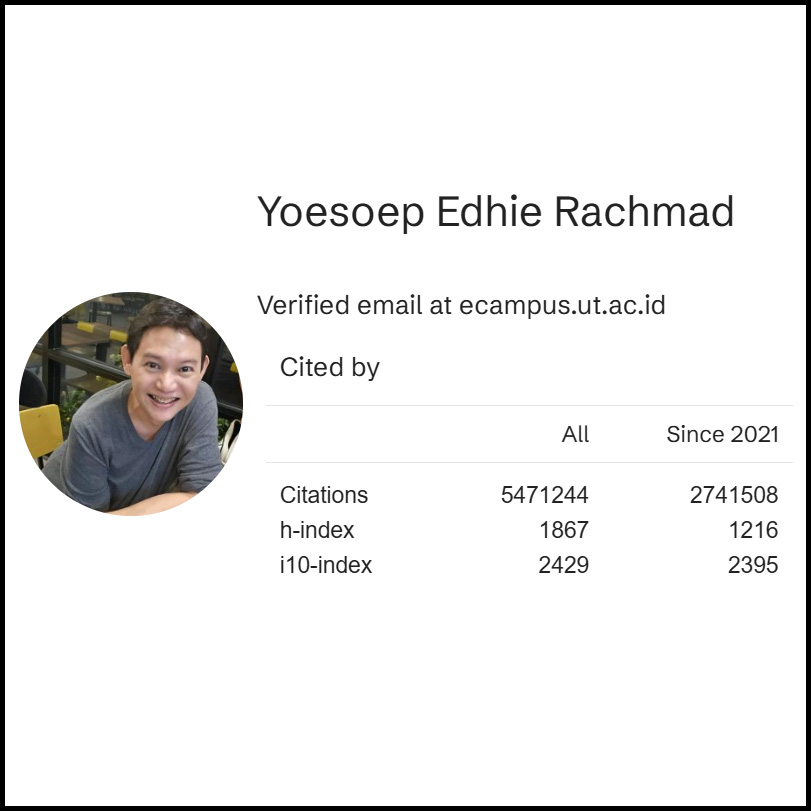
When I revisited the profile recently, the numbers had grown even further. The profile now reports 5,471,244 citations and an h-index of 1,867. That is, in just over a month the citations have increased by 410,889 and the h-index has increased by 95. I have also archived this page on Wayback machine[4].
To put that into perspective, most academics do not achieve an h-index of 95 during their entire career. Yet here is a profile that gained this increase in just a few weeks.
This article is not about one individual. Rather, it is about the questions that such a profile raises. Specifically, what does it tell us about Google Scholar, the metrics it produces, and the confidence that institutions place in those metrics?
Why Google Scholar became so popular
Google Scholar has become a go to place for researchers to access the academic literature.
Unlike subscription databases, it is free to use. It covers journal articles, conference papers, books, theses, preprints, reports and a wide range of other scholarly material. For many researchers, it provides the most comprehensive view of their scholarly output and citations.
Google Scholar also updates relatively quickly. New publications often appear within days or weeks, and citations can be tracked across a much broader range of sources than those indexed by more selective databases.
These strengths explain why Google Scholar has become one of the most widely used research tools in the world. Many researchers maintain a public profile, and many institutions refer to Google Scholar metrics when assessing academic performance.
Indeed, when scholars cite an h-index they are almost always referring to Google Scholar. This is for two reasons. Firstly, this h-index is generally higher than the Scopus and Web of Science h-index. Secondly, it is easily accessible, so anybody can look at it. If you want to read more about this topic, I published an article in 2024, which you might find useful[5].
Yet the very characteristics that make Google Scholar attractive also create vulnerabilities.
How Google Scholar differs from other databases
Traditional citation databases, such as Scopus and Web of Science, operate using carefully controlled indexing processes. Journals are assessed before inclusion, records are curated, and metadata is monitored.
Google Scholar takes a different approach.
Its objective is to discover and index scholarly content wherever it can be found. This broad coverage is one of its greatest strengths, but it also means that the platform operates at a scale that makes detailed human oversight difficult.
As a result, Google Scholar sometimes indexes content that would not be accepted by more selective databases. It may also encounter challenges in accurately identifying authors, merging records, or determining whether documents genuinely represent scholarly outputs.
Most of the time these issues are relatively minor. Occasionally, however, they can produce results that raise significant questions.
Can Google Scholar be manipulated?
The short answer is yes.
Researchers have demonstrated a variety of ways in which citation metrics can be artificially inflated[6]. Some methods are relatively simple, while others are more sophisticated.
For example, documents containing large numbers of references can be uploaded to websites that are indexed by Google Scholar. If those references are recognised as citations, citation counts may increase. Duplicate records can also create complications, particularly when multiple versions of a document exist across different platforms. Articles, which have not been (co-)authored by the profile owner, can be added to a profile thus hijacking the citations.
Researchers have also documented cases involving citation farms, coordinated citation networks and various attempts to exploit automated indexing systems.
None of this means that every unusual profile is necessarily the result of deliberate manipulation. There may be technical explanations, indexing errors, duplicated content or other factors at work. And, of course, some high performing profiles are actually valid due to hard work (and acting ethically). However, the existence of known vulnerabilities means that unusual metrics deserve scrutiny rather than automatic acceptance.
The problem with large numbers
One of the challenges with research metrics is that very large numbers can create an illusion of authority.
If a researcher has an h-index of 40, most academics can intuitively understand what that means. If someone has an h-index of 90, it is clear that they have had substantial impact within their field.
It is possible for an h-index to go over 100, but very few scholars achieve. If an h-index reaches four figures you should certainly question it. Of course, it might be (ethically) valid but the probability is that it has been (unethically) manipulated.
Research evaluation should never rely solely on accepting metrics at face value. The larger and more unusual the numbers become, the greater the need for verification.
Should universities trust Google Scholar metrics?
This is perhaps the most important question.
Many universities ask applicants to provide citation counts and h-indexes during recruitment, promotion and appraisal exercises. In some cases, these figures are copied directly from Google Scholar profiles.
The problem is not that Google Scholar is useless. Far from it. The problem is that metrics can easily acquire a level of authority that exceeds their reliability.
An h-index is only as good as the underlying data (garbage in, garbage out). If the data are incomplete, inaccurate or manipulated, the metric itself becomes unreliable.
Universities therefore need to treat Google Scholar metrics as indicators rather than definitive measures of research quality. They should be used alongside peer review, publication quality, contribution to the field, research leadership, societal impact and other forms of evidence.
Metrics can inform judgement, but they should never replace it.
The wider lesson
The most important lesson is not whether one particular profile is accurate, but that research evaluation systems are only as strong as the data that underpin them.
Academia increasingly relies on quantitative indicators. Citation counts, h-indexes, impact factors, CiteScores and rankings are all used to support important decisions. Yet every metric has limitations, assumptions and vulnerabilities.
When metrics are treated as objective facts, those limitations are often forgotten.
Good governance requires us to ask questions. Where did the data come from? How were the numbers calculated? Can they be verified? Are they plausible? What incentives do they create?
These questions are just as important as the metrics themselves.
Final thoughts
Google Scholar remains an extraordinarily valuable tool. It has democratised access to citation data, increased the visibility of research and helped countless scholars discover relevant literature.
However, it was designed as a discovery platform, not as an audit-grade research evaluation system.
The profile that prompted this article may ultimately be explained by manipulation, indexing anomalies, technical issues, or a combination of factors. Regardless of the explanation, the case serves as a useful reminder that metrics should always be interpreted critically.
When an h-index increases by 95 points in a month, the real question is not whether the number is impressive, it is whether we understand where the number came from and do we have enough understanding about these metrics to question it.
About the author
Graham Kendall is Acting Vice-Chancellor of GlobalNxt University, Malaysia, and Emeritus Professor at the University of Nottingham.
He writes regularly on research integrity, governance, higher education leadership and the changing dynamics of academic publishing.
[1] LinkedIn post: https://www.linkedin.com/feed/update/urn:li:activity:7454708309405765633
[2] X post: https://x.com/fake_journals/status/2048960652148953599
[3] https://web.archive.org/web/20260428163152/https://scholar.google.com/citations?hl=en&user=fm3iBmgAAAAJ
[4] https://web.archive.org/web/20260601151103/https://scholar.google.com/citations?hl=en&user=fm3iBmgAAAAJ
[5] Kendall, G. 2024. More Transparency is Needed When Citing h-Indexes, Journal Impact Factors and CiteScores. In Publishing Research Quarterly, 40 (1): 80-99. http://dx.doi.org/10.1007/s12109-024-09983-3
[6] Delgado López-Cózar, E., Robinson-García, N., & Torres-Salinas, D. 2014. The Google Scholar experiment: How to index false papers and manipulate bibliometric indicators. Journal of the Association for Information Science and Technology, 65(3), 446–454. https://doi.org/10.1002/asi.23056