

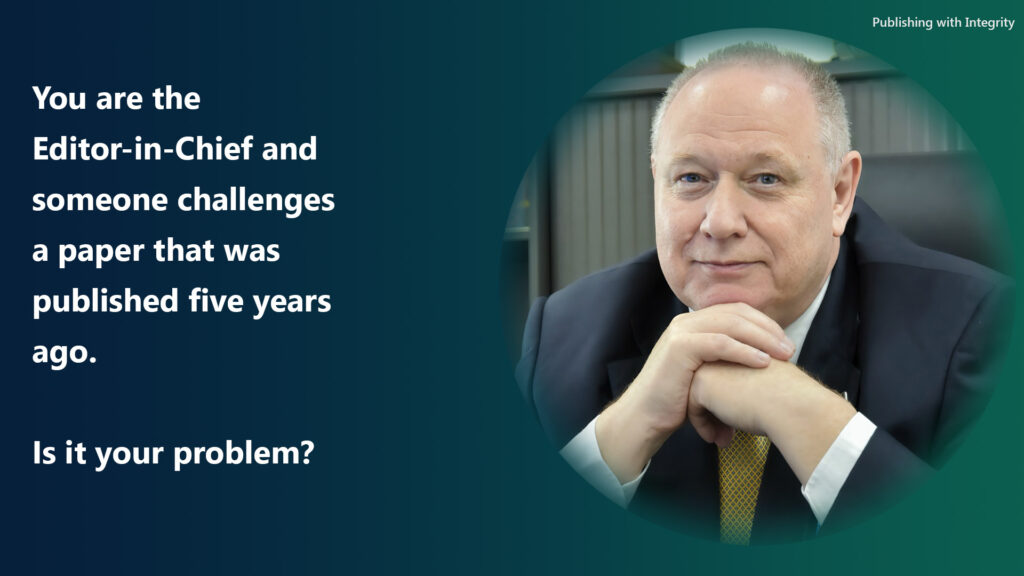
You have just become Editor-in-Chief of a journal. A few weeks later, an email arrives raising serious concerns about a paper published five years ago. Perhaps there are questions about manipulated images. Perhaps the peer review appears to have been compromised. Perhaps an authorship dispute was never properly resolved.
The paper was submitted, reviewed, accepted and published long before you became Editor-in-Chief. You had nothing to do with any of those decisions. So, is it your problem?
I think it is, but that does not mean you are responsible for what happened five years ago. There is an important distinction between responsibility for the original decision and responsibility for what happens next.
You did not make the original decision
An incoming Editor-in-Chief cannot reasonably be held personally responsible for every decision made under previous editorial leadership. You did not choose the reviewers, assess their reports, correspond with the authors or decide that the paper should be accepted. If mistakes were made, they were not your mistakes.
The difficulty is that the article has not disappeared simply because the editorial leadership has changed. It remains part of the journal. Readers can still find it, cite it and potentially rely upon its findings. The journal may have a new Editor-in-Chief, but it has not acquired a new scholarly record.
That means the question is no longer simply: Who was responsible then? It is also: Who is responsible now?
The responsibility follows the journal
We often talk about an Editor-in-Chief being responsible for a journal. Normally, we mean responsibility for the manuscripts being submitted today: ensuring appropriate peer review, making publication decisions and maintaining editorial standards. But responsibility surely has to extend beyond the manuscripts currently moving through the editorial system.
An academic journal has a history. Its published articles remain part of the scholarly literature long after the editors who accepted them have moved on. If credible evidence emerges that something within that record may be wrong, somebody has to respond. It would be extraordinary if nothing could be done simply because the editor who accepted the article had retired, resigned or moved elsewhere.
Changing the Editor-in-Chief cannot reset the integrity clock. So, although an incoming EiC does not inherit personal responsibility for the decisions of their predecessor, I would argue that they inherit responsibility for helping to protect the journal’s published record.
Put more simply: you do not inherit the blame, but you do inherit the problem.
But do you inherit the authority?
This is where things become less straightforward. Imagine that you investigate the five-year-old article and conclude that something is seriously wrong. Can you issue a correction, expression of concern or retraction concerning a paper that you never handled?
I think you must be able to. Otherwise, the ability of a journal to correct its own record would depend upon whether the people who originally made the publication decision were still in office. That would be an unsustainable model.
The incoming EiC should not simply reopen previous editorial decisions because they personally would have decided differently. The fact that you would have rejected a paper that your predecessor accepted is not, by itself, an integrity issue. There must be a substantive reason to revisit the published record.
That distinction matters. The authority to investigate historical integrity concerns should not become an authority to rewrite the editorial history of the journal according to the preferences of its latest editor.
Where does the publisher fit?
This brings us to another question: if the EiC is responsible for the journal, what is the publisher responsible for?
I do not think the answer should be that publishers simply make these decisions themselves. Editorial independence matters, and decisions about the scholarly literature should not become commercial or managerial decisions made by somebody because they happen to own or publish the journal.
But neither do I think the publisher can simply stand aside and say that everything is the Editor-in-Chief’s problem. Publishers provide continuity that individual editors cannot. They may hold the historic submission records, operate the editorial systems, employ research-integrity staff, provide procedural and legal support, and ensure that corrections, expressions of concern and retractions are properly implemented and permanently linked to the published record. They also have to ensure consistency across the entire portfolio, so that the same standards are applied across all of their journals.
Perhaps we need to distinguish between editorial judgement and governance responsibility. The EiC should normally exercise scholarly and editorial judgement. The publisher should provide the processes, records, expertise and governance that enable that judgement to be exercised properly.
Neither should be able to point at the other when something difficult arises.
What if the problem involves the editor?
There is another reason why responsibility cannot rest entirely with one person. Suppose the five-year-old paper was accepted not by your predecessor, but by you. Perhaps you were already Editor-in-Chief when it was published and you personally handled the manuscript.
Five years later, convincing new concerns emerge. Should you be solely responsible for investigating whether your own previous decision was wrong?
That creates an obvious difficulty. Even the most conscientious editor may have a perceived or actual conflict of interest when asked to review their own earlier actions. In such circumstances, the journal needs somewhere else to go.
That might mean another senior editor, an editorial board, an ethics committee, the scholarly society that owns the journal or a specialist research-integrity team within the publisher. The exact mechanism may differ between journals, but the principle should not.
A journal needs governance arrangements capable of dealing with integrity concerns even when those concerns involve the person who would normally deal with them.
A change of editor should not create an integrity gap
This is why I think the apparently simple question of an old paper and a new Editor-in-Chief exposes something much bigger. Academic journals outlive their editors. An EiC may serve for three years, five years or ten years, while the papers published during that period can remain part of the scholarly literature indefinitely.
There has to be continuity of responsibility. That does not mean holding today’s editor accountable for yesterday’s mistakes, nor should incoming editors spend their first months searching through the back catalogue looking for decisions with which they disagree.
It means something much narrower and, I think, much more defensible. When a credible concern is raised about something the journal has published, the journal has a responsibility to address it, irrespective of who happened to be Editor-in-Chief when the article was accepted.
The current EiC will usually have an important role in that process. The publisher may also have an important role. In some cases, other editors, institutions or integrity specialists will need to become involved. But somebody must take ownership because the scholarly record belongs to the journal for much longer than any individual occupies the editor’s chair.
So, you become EiC tomorrow and someone challenges a paper published five years ago. Is it now your problem?
I think it is. Not because you made the original decision, but because you are now one of the people responsible for what the journal does next.
About the Author
Graham Kendall is Vice-Chancellor of GlobalNxt University and an Emeritus Professor at the University of Nottingham. He has published more than 300 peer-reviewed papers and has held senior editorial roles, including Editor-in-Chief of the IEEE Transactions on Computational Intelligence and AI in Games and Associate Editor of the Journal of the Operational Research Society.
If You Liked This Edition
I publish two free LinkedIn newsletters:
Governance, Leadership & Research Thoughts on leadership, universities, research, AI and organisational life.
Publishing with Integrity Exploring research integrity, academic publishing and the systems surrounding scholarly communication.