

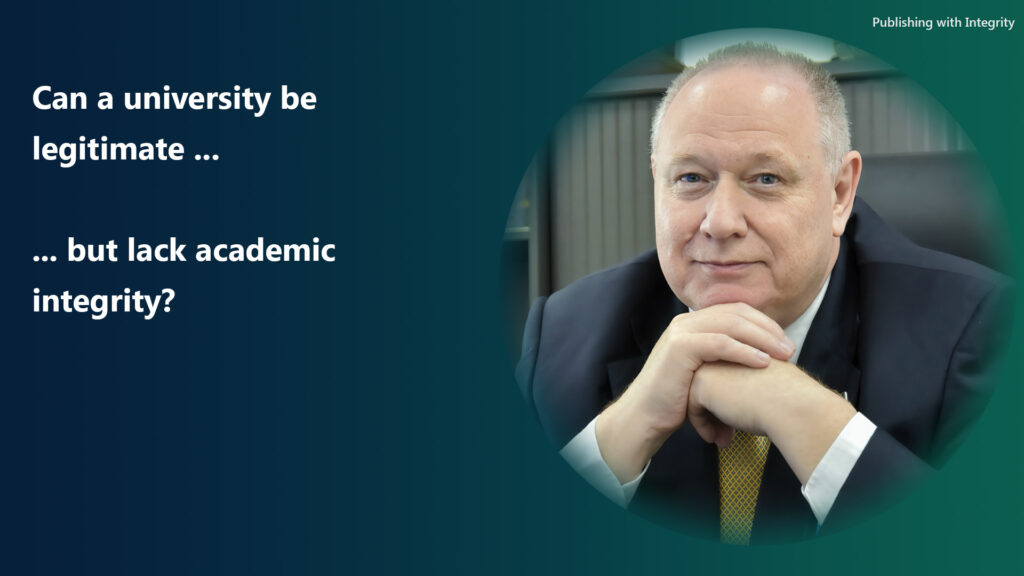
Could universities be predatory?
You are probably familiar with the concept of predatory journals. These are journals that may look legitimate, complete with editorial boards, impressive websites and promises of rigorous peer review. However, predatory journals provide little of the editorial oversight and the quality assurance that researchers have a right to expect.
This got me thinking about universities. Fake universities exist, qualifications can be bought and some institutions falsely claim to have accreditation. However, I am interested in something a little different. Could a university be legally recognised, have accredited programmes, employ appropriately qualified academics and award legitimate qualifications, yet still operate in ways that undermine academic integrity?
In other words, could there be a university that appears legitimate in almost every respect but behaves in ways that we would find unacceptable if similar practices occurred within a scholarly journal?
I suspect the answer is yes, although deciding what constitutes predatory behaviour is more complicated than it might initially appear. The same, of course, is true of journals.
What would make a university predatory?
In 2019, Grudniewicz and colleagues published a definition of predatory journals and publishers. Their definition identified organisations that prioritise self-interest at the expense of scholarship, often using misleading information, deviations from accepted publishing practices, a lack of transparency and aggressive solicitation.
Importantly, charging publication fees does not make a journal predatory. Many reputable journals charge article processing charges and provide legitimate editorial services. The concern arises when an organisation misrepresents what it offers, fails to deliver expected services or exploits those who place their trust in it.
I wonder whether similar principles could apply to universities.
Imagine a university that aggressively recruits students, makes ambitious promises about the quality of its education and the career opportunities available to graduates, but provides inadequate academic support, limited learning resources or staff who are not suitably qualified.
Or consider an institution that continues enrolling doctoral candidates despite knowing that it lacks the expertise or research environment necessary to support them properly. The students may pay substantial fees, devote several years to their studies and eventually discover that the institution cannot provide the supervision they reasonably expected.
These examples might indicate inadequate academic provision, but that alone does not necessarily make an institution predatory. Universities can experience financial difficulties, make poor decisions and fail to meet expectations without deliberately exploiting students.
The distinction becomes more significant when an institution knows that it cannot deliver what it promises, continues recruiting students and fails to disclose those shortcomings. At that point, we are moving beyond poor performance into questions of institutional integrity.
Is there any evidence of this happening?
There are documented cases that demonstrate how questionable practices can occur within formally established higher education institutions.
In December 2019, the US Federal Trade Commission (FTC) announced a $191 million settlement with the University of Phoenix. The FTC alleged that the university had used misleading advertising suggesting relationships with major employers that would provide particular employment opportunities for students. The settlement included $50 million in payments and the cancellation of $141 million in student debts. The university did not admit wrongdoing.
This does not establish that the University of Phoenix was a predatory institution, nor does it demonstrate that its academic programmes lacked integrity. However, it illustrates how recruitment practices at a recognised institution can become the subject of substantial regulatory action.
The consequences for students can be considerable. Choosing a university often involves a substantial financial commitment, several years of study and decisions that may influence an individual’s career and personal circumstances.
When students enrol, they reasonably expect that the information used to attract them is accurate and that the university can deliver the education it has promised.
We criticise journals that mislead authors about their editorial processes, indexing or reputation. It seems reasonable to apply comparable expectations to universities when they communicate with prospective students.
Academic integrity is also an institutional responsibility
When we discuss academic integrity, we tend to focus on the actions of individuals. We examine plagiarism, fabricated research, manipulated images, questionable authorship and other forms of academic misconduct.
Universities typically have policies that establish expectations for students and academic staff. They may investigate suspected misconduct, impose penalties and require individuals to complete training to ensure that they understand their responsibilities.
But academic integrity also depends on decisions made by the institution itself.
Consider admissions, assessment and graduation. These are fundamental academic responsibilities, yet they can also have financial implications. Admitting more students generates additional income, while retaining students can help protect that income.
There is nothing inherently inappropriate about universities wanting students to enrol, progress, complete their qualifications and move on to a higher degree. Indeed, institutions should provide appropriate support to help students succeed and progress.
The concern arises if academic decisions are influenced by considerations unrelated to academic merit. For example, what happens if staff are pressured to pass students who have not demonstrated the required knowledge or ability? What if assessment standards are reduced to improve progression rates, or students are admitted despite serious doubts about their ability to meet programme requirements?
I am not suggesting that these practices are widespread. Rather, they illustrate circumstances in which an institution’s interests could conflict with its responsibility to maintain academic standards.
If a university expects students to behave with integrity, surely it should apply equally demanding standards to the decisions it makes about their education.
What about research integrity?
There is also the relationship between universities and the research conducted by their academic staff.
Universities understandably celebrate publication numbers, citations, research grants and international rankings. These achievements can enhance institutional reputation, attract students and provide evidence of academic success.
However, research performance also creates incentives that may not always encourage responsible behaviour. An institution that places emphasis on publication counts, for example, needs to ensure that its expectations do not encourage questionable research practices.
More importantly, what happens when concerns are raised about research that has already been published? Suppose an academic has several publications questioned because of suspected data fabrication, manipulated images or other serious problems. Journals may initiate investigations, request explanations or eventually retract the affected papers.
The university also has responsibilities. It may be better placed than a journal to access original research data, examine institutional records and investigate the conduct of those involved.
Does the institution investigate appropriately and cooperate with the relevant journals? Does it take corrective action where misconduct is established, even if the findings might damage its reputation?
These are not simply administrative questions. An institution that promotes research achievements but fails to address credible concerns about their integrity risks undermining the scholarship on which its reputation depends.
Considerable time has been spent discussing the responsibilities of journals and publishers when research misconduct is suspected. Perhaps we should pay as much attention to how universities fulfil their corresponding responsibilities.
Are doctoral students particularly vulnerable?
I think doctoral education deserves particular consideration because of the substantial commitment students make and the importance of appropriate academic supervision.
A university may be accredited to offer doctoral programmes, but this does not automatically establish that it has the expertise and resources to support research in every field.
A prospective doctoral student might reasonably expect a supervisor with relevant research experience, access to appropriate literature and facilities, opportunities for research training and sufficient time for meaningful academic guidance.
Yet the presence of qualified academic staff does not necessarily mean that those individuals have the capacity to supervise effectively. A supervisor might have extensive teaching responsibilities, administrative commitments or a large number of existing research students.
There is also the question of whether the university provides an appropriate research environment. This need not necessarily involve expensive laboratories or a large physical campus. Online and distance education can be entirely appropriate, provided students receive the resources and academic support necessary for their research.
The issue is whether the university can deliver what it promises.
If an institution knowingly recruits doctoral candidates into areas where it lacks the necessary supervisory expertise or resources, I would regard that as a serious concern. Students may invest several years pursuing a qualification, only to discover that the promised academic support is inadequate.
This is particularly troubling when the deficiencies were known before the students enrolled.
Does accreditation guarantee academic integrity?
Accreditation is an essential part of higher education. It provides assurance that institutions and programmes have been assessed against established standards, helping to protect students and maintain confidence in academic qualifications.
However, we should distinguish between meeting formal requirements and consistently behaving with academic integrity.
An institution might satisfy accreditation requirements when its programmes are assessed but subsequently allow academic provision to deteriorate. It might have appropriately qualified staff without providing sufficient time for teaching and supervision or possess detailed policies that are not consistently implemented.
Of course, accreditation systems vary between countries, and the extent to which they examine institutional governance, academic standards and quality assurance can differ considerably. The important point is that we should not assume that accreditation is simply a paperwork exercise.
It is difficult to see how any accreditation system could guarantee the integrity of every decision made within a university. This means that legal recognition and programme accreditation, while necessary safeguards in many systems, should not be treated as conclusive evidence of how an institution behaves in practice.
A university can satisfy formal regulatory requirements yet still make decisions that deserve closer scrutiny.
Is the pursuit of profit the problem?
I do not think so.
Universities need to be financially sustainable. They must recruit students, employ staff, maintain facilities, invest in learning resources and provide academic support. These activities require income, and there is nothing inherently inappropriate about institutions seeking surpluses or operating commercially.
Nor should we assume that private universities are more likely to compromise academic integrity than public institutions. Both can face difficult financial circumstances, and both can make decisions that affect the quality of the education they provide.
A commercially successful university may maintain excellent academic standards, while a financially struggling institution may remain strongly committed to its academic responsibilities.
The problem arises when institutional interests lead to misleading claims, compromised academic standards or a failure to deliver what students have been promised.
This is why I am cautious about describing institutions as predatory. The term implies something more serious than poor management or inadequate provision. I would expect convincing evidence of deliberate deception, systematic exploitation or similarly serious misconduct before applying it to a university.
Perhaps we need to distinguish more carefully between institutions that perform poorly, those that lack sufficient resources and those that knowingly exploit students. They present different problems and should not automatically be placed in the same category.
Should universities face the same scrutiny as journals?
The scholarly publishing community has spent many years discussing predatory journals, questionable editorial practices, research misconduct and the responsibilities of publishers.
We examine whether journals conduct genuine peer review, provide accurate information about their indexing, disclose publication charges and correct the scholarly record when problems are identified.
I wonder whether we should apply comparable scrutiny to the universities where research is conducted and where academic qualifications are awarded.
This would mean examining whether institutions recruit students honestly, protect academic standards, provide appropriate supervision and respond properly when concerns about misconduct arise.
None of this requires us to label particular universities as predatory. Indeed, I am increasingly uncomfortable with using that term in the context of universities. It seems to me that we need a better description, but until we have a clearer understanding of the problem, I am not sure what that should be.
What concerns me more is the assumption that an institution’s legal recognition, accreditation and reputation necessarily demonstrate that it operates with academic integrity.
These are important indicators, but they do not tell us everything about institutional behaviour.
Perhaps the scholarly publishing community, having devoted considerable attention to the integrity of journals, publishers and individual researchers, should extend that attention to universities themselves.
We expect journals to deliver what they promise and to uphold accepted scholarly standards. Should we not expect the same from universities, regardless of whether they are legally recognised and accredited?
I would welcome your views, particularly on whether predatory university is a useful description or whether it risks confusing deliberate exploitation with poor academic provision.
I publish two free newsletters each week
Governance & Research in HE
A weekly brief for higher education leaders and researchers examining governance, leadership and research in practice.
https://buff.ly/GhsZqVl
Publishing with Integrity
Examining scholarly publishing through an ethical lens, challenging assumptions and supporting academic career development.
https://buff.ly/WiG1yFb
If you subscribe, you will be alerted whenever I publish a new edition.
About the author
Professor Graham Kendall is an Emeritus Professor at the University of Nottingham and has held senior university leadership positions in Malaysia, including Vice-Chancellor, Provost and Deputy Vice-Chancellor. His academic background is in computer science, artificial intelligence and operational research, and he has published over 300 peer-reviewed papers and supervised over 25 PhD students. His interests include research integrity, scholarly publishing, university governance and the responsibilities of higher education institutions.