

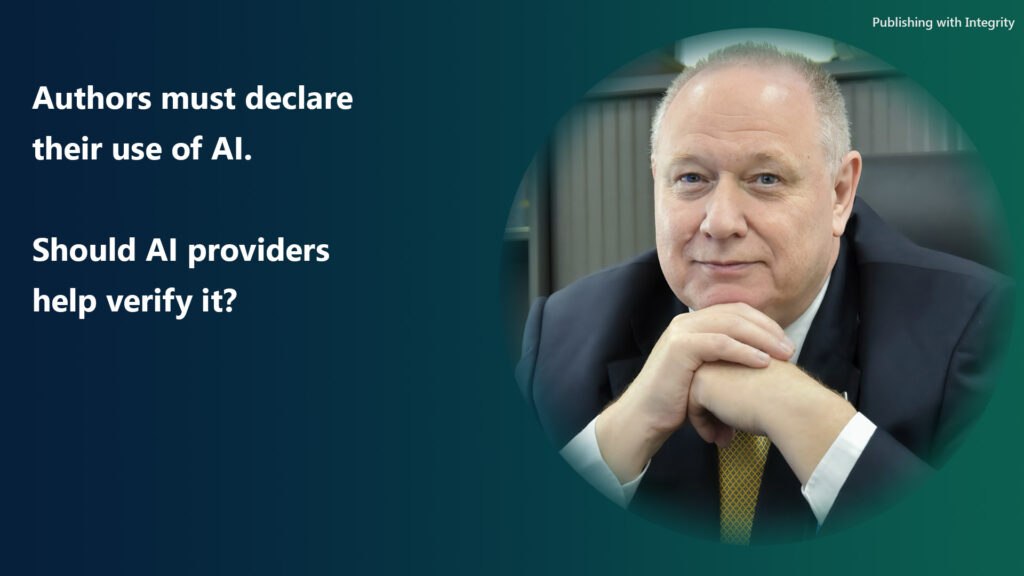
When an AI declaration is questioned
Imagine that a journal editor receives a manuscript with no declaration of AI assistance. During peer review, a concern emerges that an AI platform may have helped prepare substantial parts of it, and the editor asks the authors for an explanation.
Suppose their response leaves the concern unresolved. The editor then approaches the company believed to have provided the assistance and asks whether its services were used. What responsibility, if any, should that company have to answer?
A declaration depends on honesty
Elsevier’s policy provides one example of the expectations placed on authors. It requires disclosure of generative AI assistance in manuscript preparation, while exempting basic checks of grammar, spelling and punctuation. Substantive changes to sentence structure or organisation should be disclosed.
That distinction matters because “Did you use AI?” is often too broad a question. A useful declaration explains what assistance was provided and allows that use to be assessed against the relevant policy.
Declarations also serve a purpose even when verification is difficult. They establish expectations, encourage authors to reflect on their practices and create a record against which later evidence can be considered. But when an author deliberately withholds information, a declaration alone cannot resolve the problem.
Should the provider answer?
Jenni and SciSpace are AI providers that regularly appear in my social media feeds. I mention them to make the question concrete, without suggesting that either has acted improperly or assuming how either would respond to an enquiry.
An AI provider might appear well placed to establish what happened. If it holds relevant records, perhaps it could confirm whether a particular document was processed and what assistance was requested. But that assumes the records exist, can be reliably linked to the submitted manuscript and show more than fragments of an earlier draft.
There is also a confidentiality problem. Researchers may entrust platforms with unpublished findings and unfinished arguments, alongside information about collaborators or research participants. Sharing those records could expose considerably more than the activity an editor wants to investigate.
Jenni’s privacy policy, for example, sets out circumstances for disclosing personally identifying information, including specified legal requests and certain circumstances involving the protection of rights. Those provisions should not be read as a promise to confirm customer activity whenever a journal asks.
Legal permission and ethical responsibility
The legal question cannot be answered for every provider, author and journal with a single rule. Applicable law and the circumstances of the request matter, and a journal’s publication requirements do not themselves establish a provider’s legal duty to disclose information.
UK Information Commissioner’s Office guidance illustrates one constraint: sharing personal data requires a lawful basis. An editor’s understandable interest in investigating a manuscript does not remove the need to establish that basis.
The ethical question remains open. Companies serving researchers have reason to support trustworthy scholarship, but they also have responsibilities towards customers whose information they hold. Protecting confidentiality should not automatically be interpreted as obstructing an investigation.
There is a useful distinction here between responding to an enquiry and disclosing information about an individual. I would argue that providers serving the research community should publish a procedure for legitimate integrity enquiries. They could explain what requests they can consider and what authorisation is needed, without confirming whether a named researcher even has an account.
What would verification establish?
Suppose a provider could confirm that a manuscript had been uploaded. That would establish an interaction with the platform, but it would leave several important questions unanswered.
A researcher might have uploaded their own draft to request comments on its organisation. A co-author might have checked references, or someone might have processed the article after publication. The timing, purpose and relationship to the submitted version would all matter.
Even a record of generated text would require interpretation. Suggestions may have been rejected, substantially rewritten or used in a way the journal permits. Investigators would still need to establish what happened and which policy applied at submission.
The reverse inference would be equally unsafe. A provider’s inability to find a record would not prove that no AI assistance occurred, while its refusal to disclose information would not prove that it had something to conceal.
A proportionate route to investigation
The first step should ordinarily be to ask the authors about the specific concern. They should have an opportunity to explain their workflow, clarify a declaration and provide relevant evidence. An unclear policy or an honest misunderstanding should not automatically be treated as deliberate deception.
Where a substantial concern remains unresolved, a publisher’s integrity team or the authors’ institution might consider whether a provider enquiry is justified. The request should identify the question being investigated and explain why less intrusive evidence is insufficient.
Author-authorised verification could be one option worth exploring. Authors could be asked to authorise a specific enquiry about whether a named provider assisted with the manuscript. However, blanket permission obtained through a submission checkbox would require careful scrutiny. Any proposed process would need proper legal assessment and clear limits.
Editors must also consider the information they disclose while making an enquiry. Sending a confidential manuscript to another company to establish whether it has seen the document already creates its own confidentiality problem. A verification process would need to address this before documents start changing hands.
Records have costs as well as benefits
Verification also depends on what providers retain. Requiring detailed histories to be stored for possible future investigations would create additional repositories of confidential research material.
I would be cautious about making comprehensive retention the price of research integrity. A more defensible starting point is for providers to explain what evidence their systems can supply, its limitations and their retention practices. Publishers could then design procedures around realistic capabilities.
Authors remain responsible for truthful declarations and for the work they submit. Providers should not become substitutes for that accountability, but there is a reasonable case for asking them to explain how they can support legitimate enquiries.
The next step should be a discussion between publishers, researchers and providers about a workable process. That process should make concerns examinable while protecting authors from unsupported allegations and unnecessary disclosure of their private work.
A final thought
AI providers could make acknowledgement of relevant assistance a condition of using their services. That would not resolve the verification problem, because authors could still fail to acknowledge the assistance, but it would make the provider’s expectations explicit.
This connects with a question I explored around ten years ago in “Is There a Role for Publication Consultants and How Should Their Contribution be Recognized?” Although that paper was not about AI, it considered whether external assistance should be acknowledged. My argument was that it should, and the same principle deserves consideration here.
I publish two free newsletters each week
Governance & Research in HE
A weekly brief for higher education leaders and researchers examining governance, leadership and research in practice.
https://buff.ly/GhsZqVl
Publishing with Integrity
Examining scholarly publishing through an ethical lens, challenging assumptions and supporting academic career development.
https://buff.ly/WiG1yFb
If you subscribe, you will be alerted whenever I publish a new edition.
About the author
Professor Graham Kendall is an Emeritus Professor at the University of Nottingham and has held senior university leadership positions in Malaysia, including Vice-Chancellor, Provost and Deputy Vice-Chancellor and a Pro-Vice Chancellor in the UK. His academic background is in computer science, artificial intelligence and operational research, and he has published over 300 peer-reviewed papers and supervised over 25 PhD students. His interests include research integrity, scholarly publishing, university governance and the responsibilities of higher education institutions.