

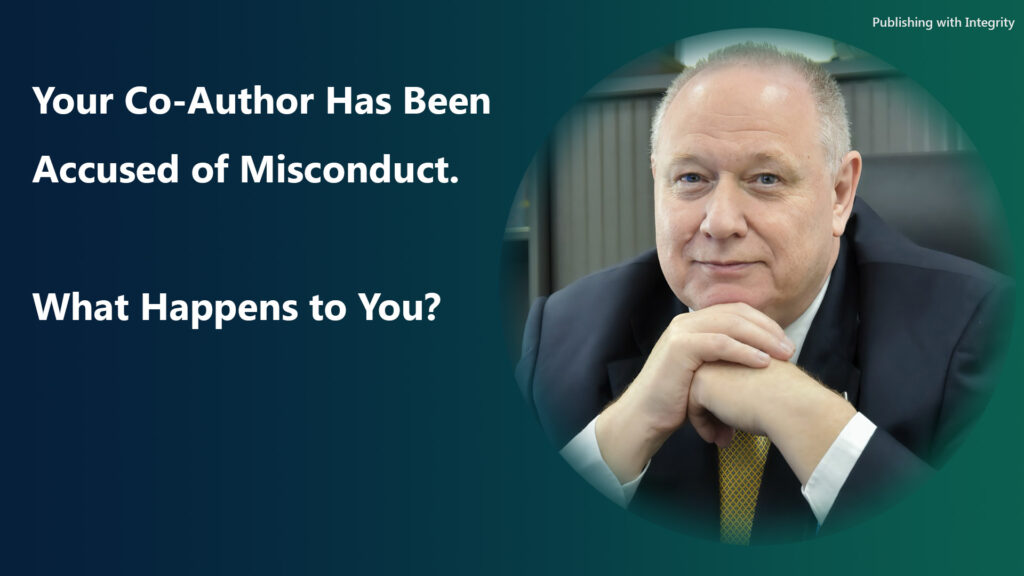
Every researcher is happy to share the credit. Far fewer are willing to share the responsibility. Modern research depends on collaboration, and collaboration depends on authorship. Yet while journals devote considerable effort to deciding who deserves to be listed as an author, they devote surprisingly little attention to what authorship actually means once something goes wrong.
If your paper wins an award, every author proudly includes it on their CV. If the paper is retracted, the conversation changes. Suddenly the authorship list becomes divided between those who ‘did the work‘ and those who ‘were only involved in part of the project‘.
Collaborative Research
Over the past two decades, research has become increasingly collaborative. Multi-institutional, multidisciplinary and international teams are now commonplace. That evolution has produced better science, but it has also created a governance problem. We have normalised shared credit without ever properly defining shared responsibility.
Recognition vs Responsibility
Most discussions about authorship revolve around who deserves recognition. Debate about first authorship, corresponding author and contribution statements are common. Much less attention is given to the obligations that accompany authorship. Every author benefits when a paper is successful. Should every author also carry some responsibility when it is not?
It would (probably) be unfair to hold every co-author equally responsible for deliberate fraud committed by one individual, although some would argue that being an author carries the burden of shared responsibility. It is also difficult to argue that authorship is simply an honorary badge that carries no obligation beyond the plaudits that come with a successful paper. Somewhere between those two positions lies a balance that scholarly publishing has never adequately defined.
Areas of expertise
In small collaborations, it is reasonable to expect every author to understand the work in detail. In very large collaborations, that expectation becomes unrealistic. A statistician may never have visited the laboratory. A clinician may never have inspected the software. A laboratory scientist may never have seen the final statistical model. Modern research depends upon specialisation, and specialisation depends upon trust.
Trust, however, is not the same as accountability. If an investigation later discovers fabricated data, manipulated images or invented results, investigators will inevitably ask what the remaining authors knew, what they checked and whether they exercised reasonable oversight. Saying ‘I trusted my colleague‘ may be understandable, but it does not always answer those questions.
Allegations and Proof
A distinction must be made between an allegation and proving that there was a misconduct. Allegations can be mistaken, politically motivated or ultimately unsubstantiated. Universities and journals therefore have a responsibility to investigate thoroughly while also protecting due process. Damaging a researcher’s reputation before the evidence has been examined serves neither fairness nor research integrity.
Contribution statements
Contribution statements become particularly important when problems arise. Many authors treat these as an administrative requirement during submission. In reality, they are one of the few documents that allocate responsibility. They should therefore be completed with the same care as was afforded to the manuscript preparation itself, because they may later become central to understanding who was responsible for what.
An innocent co-author
What should an innocent co-author do? The first responsibility is cooperation. Preserve records, correspondence and datasets where possible. Understand precisely what aspect of the work is under investigation before making public statements. If concerns genuinely affect the reliability of the published work, protecting the integrity of the scholarly record must take precedence over protecting individual reputations.
The institutional dimension is equally important. Universities often focus on identifying the individual responsible for misconduct. They should also ask whether unrealistic publication targets, weak supervision, poor data governance or a culture that discouraged questioning contributed to the problem. Misconduct rarely occurs in complete isolation from the environment in which research is conducted.
Weakness in scholarly publishing
I believe that this debate exposes a deeper weakness in scholarly publishing. We have developed increasingly sophisticated rules about who qualifies for authorship, yet we have devoted remarkably little attention to what authorship actually obliges us to do. Credit is carefully allocated, yet responsibility remains vague.
Perhaps the answer is not that every author should be responsible for every detail of every paper. That would be unrealistic. Instead, every author should be responsible for understanding the work sufficiently to defend the integrity of the contribution they are claiming, while senior authors should accept additional responsibility for the governance of the project as a whole.
Authorship has never been simply about recognition. It has always implied accountability. The challenge for universities, publishers and researchers is deciding how that accountability should operate in an era of increasingly complex collaborations.
Until we answer that question, authorship will continue to distribute credit far more clearly than it distributes responsibility. Every researcher wants the citation, the promotion and the recognition. The more difficult question is whether we are willing to accept the obligations that accompany those rewards.
Did you find this edition useful?
I publish two free weekly newsletters exploring different aspects of higher education, research and scholarly publishing.
Governance & Research in HE
https://buff.ly/GhsZqVl
Publishing with Integrity
https://buff.ly/WiG1yFb
About the Author
Professor Graham Kendall is Vice-Chancellor of GlobalNxt University, Malaysia, and an Emeritus Professor at the University of Nottingham. Over the past 25 years, he has published more than 300 peer-reviewed papers and has served as Editor-in-Chief and Associate Editor of several international journals. Through Publishing with Integrity, he explores the ethical, governance and practical challenges facing scholarly publishing, encouraging greater transparency, integrity and informed debate across the global research community.